|
Richard Berwick Hope and Esme Collings Limited
Richard Berwick
Hope was
born in Coombe, near
Kingston-upon-Thames, Surrey, on
25th October 1874,
the son of Adela Henrietta Curtis and Archibald Godfrey
Hope, a manufacturer of gunpowder. Richard’s father,
Archibald Godfrey Hope (1848-1881) had been born in Madras,
India, on
7th January 1848,
the son of a high-ranking Indian Army officer, General Archibald
Hugh Hope (1820-1890).
In 1871, Archibald Godfrey Hope had married Adela Henrietta
Curtis, the daughter of Henrietta and Charles William Curtis, a
wealthy man who owned a gunpowder factory. It appears that
Archibald Godfrey Hope was brought into his father-in-law’s
business, because, at the time of the 1881 census, he was described
as a “Gunpowder Manufacturer & Merchant”.
Richard Berwick
Hope was
the third eldest child of six children born to Adela and Archibald
Hope. [Richard’s siblings were Graham Archibald Hope (born
1872), Lucius Charles Hope
(born 1873), Edith Adela Hope (born 1876),
Douglas Edmund Hope (born 1877)
and Adrian Lewis Hope (born 1878)]. In 1881, when
Richard Berwick Hope was 6 years of age, his
father, Archibald Godfrey Hope,
died at the relatively young age of 33. Richard was brought up by
his widowed mother until she married a surgeon named Percival
Kingsford in 1889.
Richard Berwick
Hope attended
Repton School
and the
Royal
Military College at Sandhurst
with the intention of pursuing a military career like his
grandfather, who had risen to the rank of General in the Madras
Cavalry. After becoming a Lieutenant in the Royal West Kent
Regiment, Richard Berwick Hope served in
India, taking part
in military action on the North West Frontier in 1897.
On 29th
April 1899,
Richard Berwick
Hope
married
Frances Catherine Lane
(born 1876, Colwick Hall, Nottinghamshire), the
daughter of
Captain Richard
Douglas Hay Lane,
a former officer in the 17th Regiment of Lancers. A baby
boy,
Richard Charles Adrian Hope,
was born to the couple on 1st August 1900, but, sadly, he
died soon afterwards. A second child, Betty Genette Hope,
arrived on 1st September 1902. Betty Hope (unlike the unfortunate Richard
Hope junior) survived infancy and reached adulthood, eventually
marrying Reverend Philip Brandon Mercier in February 1941,
when she was 38 years of age.
It appears that
Richard Berwick Hope
was not in
England, when the
census was carried out on 31st March 1901. Mrs Frances Hope, Richard’s pregnant wife was
residing in Sunbury, Middlesex, with Richard’s twenty-five year old
sister Edith Adela Hope. [Richard
Berwick Hope
was presumably serving abroad in the military when the 1901 census
was taken].
It seems that
Richard Berwick
Hope
left the British Army around 1901 to start a new career as a society
photographer.
Arthur Albert Esme
Collings (born1859,
Weston-super-Mare,
Somerset), a noted photographer, miniature painter and early film
maker, had taken control of a photographic portrait studio in London
at
69 New Bond Street
around 1890. Since 1888, Arthur Esme
Collings had been based in the
Sussex district of
Brighton &
Hove,
residing in Brighton and operating a photographic portrait
studio in
Western Road, Hove.
Around 1894, Arthur Esme Collings closed his branch studio at
69
New Bond Street,
London, and established a new photographic portrait studio at
175 New Bond Street,
London. The proprietor of the
London studio,
Arthur Esme Collings, remained in
Brighton
with his wife and young son. Arthur Esme Collings was
personally in charge of a portrait studio at
120 Western Road,
Hove,
so presumably he employed a manager to supervise his
recently opened
studio at
175 New Bond Street, London.
In November 1901,
Arthur Esme Collings and others formed
the firm of Esme Collings (Hove) Limited. Over the next few years, Esme Collings Limited took
control of studios in
Liverpool and
Manchester, in addition to Arthur Esme Collings’ original
studios in
London
and Hove. When Esme Collings (Hove)
Limited
was established in November 1901, Richard Berwick
Hope took up the position of Managing
Director.
By 1903,
Richard Berwick Hope
was in overall charge of six portrait studios, operating under the
banner of Esme Collings Limited. There were two
studios in
London – one at
175 New
Bond Street and the other at
52 New Bond Street
– two establishments in
Liverpool at
43 Rodney Street
and 65 Bold Street
and another studio in the North-West of England at 22a
King Street,
Manchester. The firm of Esme Collings Ltd also retained
control of Arthur Esme Collings’ former studio at
120 Western Road,
Hove.
For a brief period, Esme Collings Ltd also owned a third
London studio at
52 New Bond
Street.
Richard Berwick
Hope
was the Managing Director of
Esme Collings Ltd
between 1901 and 1907. For his
photographic activities, Richard Berwick Hope had adopted the
name of "Cosway", probably as a tribute to the famous
miniature painter Richard Cosway (1740-1821).
The firm of
Esme Collings Ltd specialised in the production of miniatures
and Richard Berwick Hope's several studios in London,
Brighton (Hove), Liverpool and Manchester
went under the name of the Cosway Galleries.
When
Richard Berwick Hope
gave evidence in the trial of
Mrs Margaret Pebble*, an
audacious confidence trickster, at the Old Bailey in February 1906,
he revealed details about his involvement in the firm of Esme
Collings Limited and the commercial activities of The Cosway
Galleries.
Margaret Trew Prebble was accused of
unlawfully obtaining from Esme Collings Limited a number of
photographic portraits and hand-painted miniatures by false pretences, with intent to
defraud. In his testimony,
Richard Berwick Hope,
the Managing Director of
Esme Collings
Limited and the proprietor of the Cosway Gallery,
described events which
took place in the Summer of 1905:
RICHARD BERWICK HOPE
( Managing Director of Esme Collings Limited, of 171 New
Bond Street)
"She
(Margaret Prebble) came the following day and sat for her own
photograph. On July 1st, after I had sent proofs of her
photograph, she came again. She ordered from her proofs her own
miniature, four dozen whole plate photographs, two Cosway
pictures, coloured, two Hogarth frames, and a gilt rim to be
fitted to Lord Anglesey's miniature - the value of her own
miniature was twenty guineas, and the Anglesey pictures were to
be twenty-five guineas, the rim was to be two guineas, the four
dozen photographs sixteen guineas, and the Cosway pictures £3
17s. 6d. — I call myself Cosway, and my establishment the Cosway
Gallery. She sat several times for her miniature; it had to be
reduced. ......She gave the various addresses in the letters
produced—we sent the goods she ordered, and the amount of our
account comes to £77. 7s. 6d.— it is made out to Lady Muriel
Paget..... We were never paid."
Extracts
from the testimony of Richard Berwick Hope, Managing Director of
Esme Collings Ltd, given at the Old Bailey on 5th February 1906. |
Between 1905 and
1906,
Richard Berwick Hope
contracted his photographic business by closing his studios in
Liverpool and Manchester and one of his London studios. By February
1906,
Richard Berwick Hope
was operating a single studio at 171 New Bond Street,
London, under the name of Esme
Collings Limited. [ It appears that
Richard Berwick Hope
had interests outside of photographic portraiture. In May 1906,
Richard Berwick Hope
filed a patent as the inventor of a "Blouse and Skirt Support" ].
Richard Berwick Hope
and his wife Frances divorced in 1907 after 8 years of marriage.
During the 3rd Quarter of 1907,
Richard Berwick Hope
married for a second time. His new bride was Mary Frances West
(born 1885, London), the daughter of Stephen West. During the 2nd Quarter of 1908, Richard
Berwick Hope's wife gave birth to a son named David Archibald
Hope.
In April 1907, the firm of Esme
Collings Limited was wound up. [See the Notice of Liquidation
dated 9th April 1907]. It appears that
Richard Berwick Hope
the former Managing Director of Esme
Collings Limited,
continued to operate the photographic portrait studio at 171 New Bond Street,
London, under the trade name of "Richard Cosway".
A directory of "Prominent
London Professional and Business Houses" in Webster's Royal Red
Book or Court and Fashionable Register for 1908 lists Richard Cosway (the
pseudonym of of Richard Berwick Hope) as a photographer and portrait
painter at 171 New Bond
Street, London. |
|

|
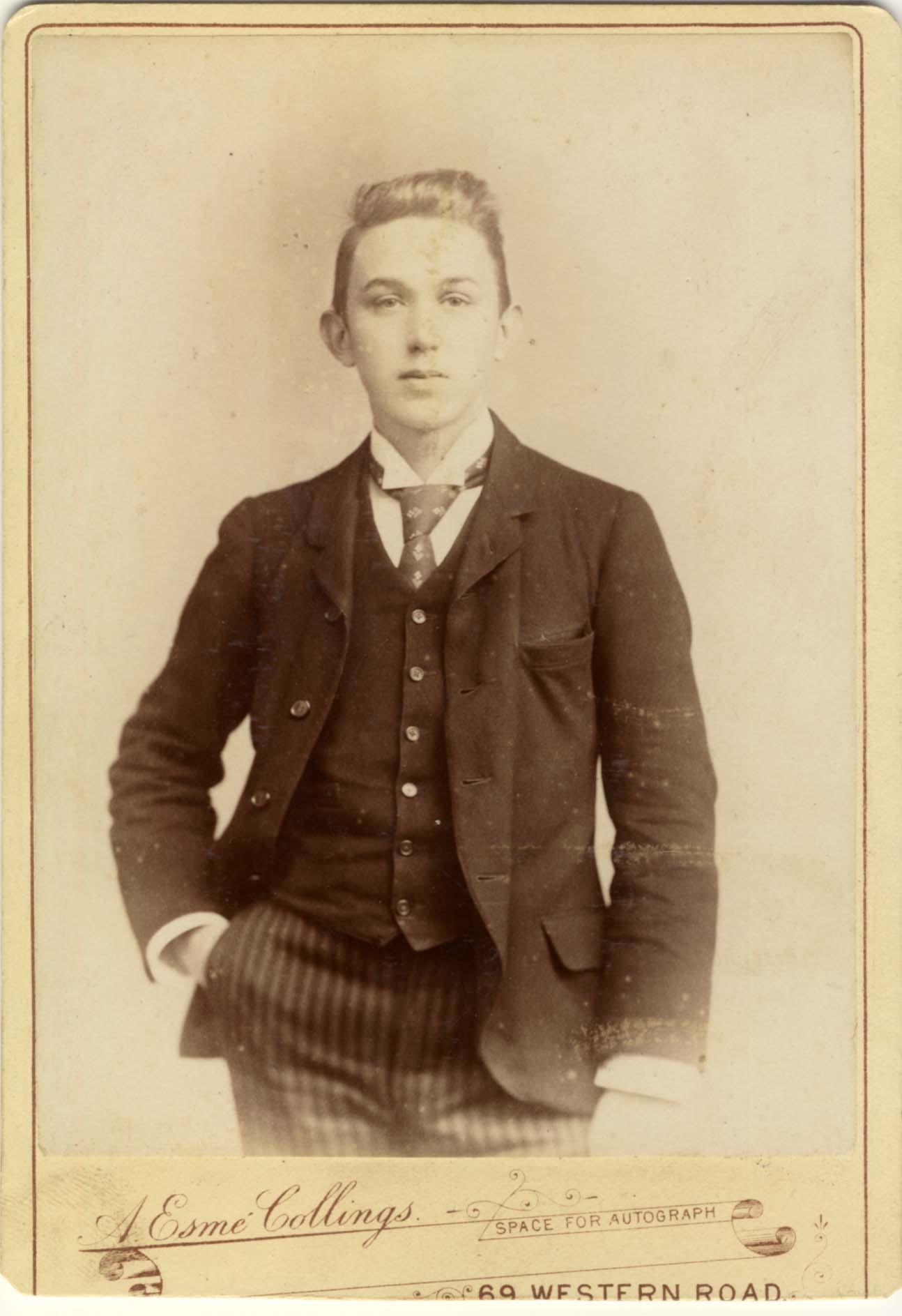
| [ABOVE]
Richard Berwick Hope (1874-1952), the Managing Director of
Esme Collings Limited and the owner of the Cosway Galleries,
photographed around 1898 when he was an officer in the Royal
West Kent Regiment.
PHOTO
SOURCE: Stuart Hallifax and his website A Forlorn Hope
|
| |
|
Esme
Collings Ltd |
|
London Studios |
175 New Bond
Street, W. |
| |
52 New Bond Street, W. |
|
Brighton |
120 Western Road, Hove |
|
Liverpool |
43 Rodney Street |
| |
65 Bold Street |
|
Manchester |
22a King Street |
|
| [ABOVE]
Details of the branch studios of Esme Collings Ltd. as
printed on the reverse of a photographic mount produced around
1905. By 1906, the studio branches in Liverpool and Manchester
had closed. |

| [ABOVE] Detail of a
portrait of a young society woman produced by Esme Collings Ltd.
(c1905) Underneath the portrait is the credit "Esme
Collings" and "Cosway Galleries" [see below].
PHOTO:
Courtesy of Steve Elliott |
 |
 |
|
[ABOVE] The trade names of "Esme
Collings" and "Cosway Galleries"
which appeared below the portraits produced by Esme Collings Ltd.
around 1905. Richard Berwick Hope, the proprietor and
managing director of Esme Collings Ltd.
specialised in the production of portrait miniatures based on
photographic portraits. A pair of platinotype photographic
prints, which were coloured by hand, were known as "Cosway
pictures" and retailed at £3 17s 6d. |
|
|
|
 |
| [ABOVE]
Richard Berwick Hope, the Managing Director of Esme Collings Limited and the owner of the Cosway
Gallery, Listed as a bankrupt in The Edinburgh Gazette,
published on 21st April 1908. |
On 13th April 1908,
Richard Berwick Hope,
described as a "Photographer", lately carrying on business at
171 New Bond Street, London, filed a Petition of Bankruptcy
at the High Court of Justice. When he filed for
bankruptcy,
Richard Berwick Hope
was residing at 154 Portsdown Road, Paddington, London.
According to the Bankruptcy Notice,
Richard Berwick Hope
had previously lived at 11 Iddesleigh Mansions, Victoria Street,
Westminster.
While the London branch of
Esme
Collings Limited was being wound up and Richard Berwick Hope was
re-launching
the portrait studio at
171 New Bond Street, London under the name of "Richard Cosway", three
business partners - Albert Winder
Grant
(born 1869, Co. Tyrone, Ireland), a stock broker, and two professional
photographers,
Hal (Henry) Lawrence (born 1873, Nottingham) and William Leonard Staines
(born 1881, London) - joined forces to take over Arthur Esme
Collings' studio in Hove, forming the firm of Esme Collings
(Hove) Ltd. The firm of Esme Collings
(Hove) Ltd was registered as a Limited Company in July 1910, but
was dissolved 18 months later in January 1912.
When the 1911 census was
taken,
Richard Berwick Hope
was recorded with his wife Mary and their young son at 135 Sloane
Street, Chelsea, London, SW. On the census return,
Richard B. Hope, then
aged 36, gives his occupation as "Army Officer Retired".
At the outbreak of the First World
War,
Richard Berwick Hope,
an experienced soldier, enlisted in the 3rd Battalion of the East
Surrey Regiment with the rank of Lieutenant. By November 1914,
Richard Berwick Hope
had become a Captain. Captain Hope was mentioned in
despatches and rose to the rank of Major in the
East Surrey Regiment.
On 15th May 1917, Richard Berwick
Hope's wife Mary gave birth to twins - Alexander Erskine Hope
and Archibald Paul Hope. [ Alexander Hope followed a
military career, attending the Royal Military College at Sandurst
and joining the Bedfordshire and Hertfordshire Regiment as a 2nd
Lieutenant in January 1937. Lieutenant Alexander Erskine Hope
was killed in action early in October 1944 while fighting German
forces in the Netherlands].
After the First World War, despite the failure of his
photographic portraiture business in London,
Richard Berwick Hope
established a new firm of "Photographic Artists and Miniature
Portrait Painters" in the seaside resort of Bournemouth. In partnership
with Dorothy Maude Powell-Jones,
Richard Berwick Hope
set up a portrait studio at Belfast House, Gervis Place, Bournemouth
under the name of "Dochard". The partnership between
Richard Berwick Hope
and Dorothy Powell-Jones was dissolved on 10th May 1921.
Richard Berwick Hope
continued to work as a photographer and portrait painter in
Bournemouth under the name of "Dochard" for a year or so.
Richard Berwick Hope
died in Poole, Dorset, on 13th September 1952 at the
age of 77.
|
*Mrs Margaret Trew Pebble
was born Maggie McKillen in Liverpool on 1st
December 1873, the daughter of an Irish-born joiner and
shop-fitter. Leaving home at the age of 20, Margaret McKillen
trained as a nurse. In 1896, assuming the name of "Nina
Margaret Stolterfoht", Margaret married a Russian-born medical
student named Earnest (Ernest) Alfred Prebble. After her
marriage, Margaret posed as "Princess Soltykoft", the
widow of a Russian nobleman named Prince Alexis Soltykoff. In
1902, Mrs Prebble was found guilty of "obtaining money by
falsely representing herself to be the Princess Soltykoff" and
sentenced to 15 months' imprisonment. On her release from
prison, Margaret Prebble returned to her nursing
career. While employed as a nurse at Winwick Hall Mental
Asylum, Margaret Prebble took on the role of "Lady
Muriel Paget", claiming to be a wealthy aristocratic lady
who possessed a large country house and the resources to own
motor-cars and employ a private secretary, a governess and a
lady's maid. Posing as "Lady Muriel Paget", Mrs Prebble
swindled large West End stores by ordering expensive "cloaks,
dresses, gowns, and various other costly articles on false
pretences". In the Summer of 1905, in the guise of "Lady
Muriel Paget", Mrs Prebble acquired from Esme Collings
Limited of New Bond Street, London, a
copy of a hand-painted miniature of the Marquis of Anglesey,
several expensive photographs, a portrait miniature of herself
and other items with the total value of 77 guineas. Found
guilty of
"unlawfully
obtaining two miniatures and other articles by false
pretences, with intent to defraud" at
the Old Bailey in February 1906, Margaret Prebble was
sentenced to 18 months imprisonment with hard labour. |
|
|
 |
| [ABOVE] Notice
of the Liquidation of Esme Collings Limited as
published in The London
Gazette of 12th April 1907. |
|
 |
| [ABOVE] Richard Berwick Hope
listed as a Photographer & Portrait Painter at 171 New Bond
Street, London, under his pseudonym of "Richard
Cosway", as printed in Webster's Royal Red
Book or Court and Fashionable Register for 1908. This
list of Photographers appeared in Webster's directory of "Prominent
London Professional and Business Houses". Printed above the
entry for Richard Cosway (Richard Berwick Hope) is the
listing for the artist and photographer Keturah Collings, the
wife of Arthur Esme Collings. |

[ABOVE] The Voluntary Liquidation
of
Esme Collings (Hove) Limited as reported in The London
Gazette of 30th January 1912. With the financial backing of
a stock broker named Albert Winder Grant, two
photographers, Hal Lawrence and William Staines had
established the firm of
Esme
Collings (Hove) Ltd in July 1910.

[ABOVE] A notice in The
London Gazette dated 9th September 1921, detailing the
dissolution of the business partnership between Richard Berwick Hope
and Dorothy Powell-Jones, who had previously worked together
as "Photographic Artists and Miniature Portrait Painters"
under the studio name of "Dochard". |