Blomfield Photo Gallery
Photographs produced at John Blomfield's studio, Trinity House, Hastings (1867-1910)
Click here to return to Home Page
|
|
|
|
|
|
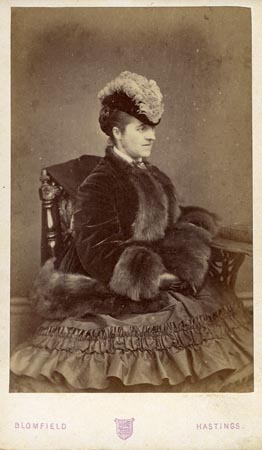
[ABOVE] A carte-de-visite portrait of a seated woman wearing a
fur-trimmed jacket, photographed
at the studio of Messrs W. & J. Blomfield, Trinity House, 44
Robertson Street, Hastings (c1870). From 1867 to 1872, John Henry Blomfield was in partnership with his older brother William Knibb
Blomfield trading under the name "Messrs W. & J. Blomfield".
|
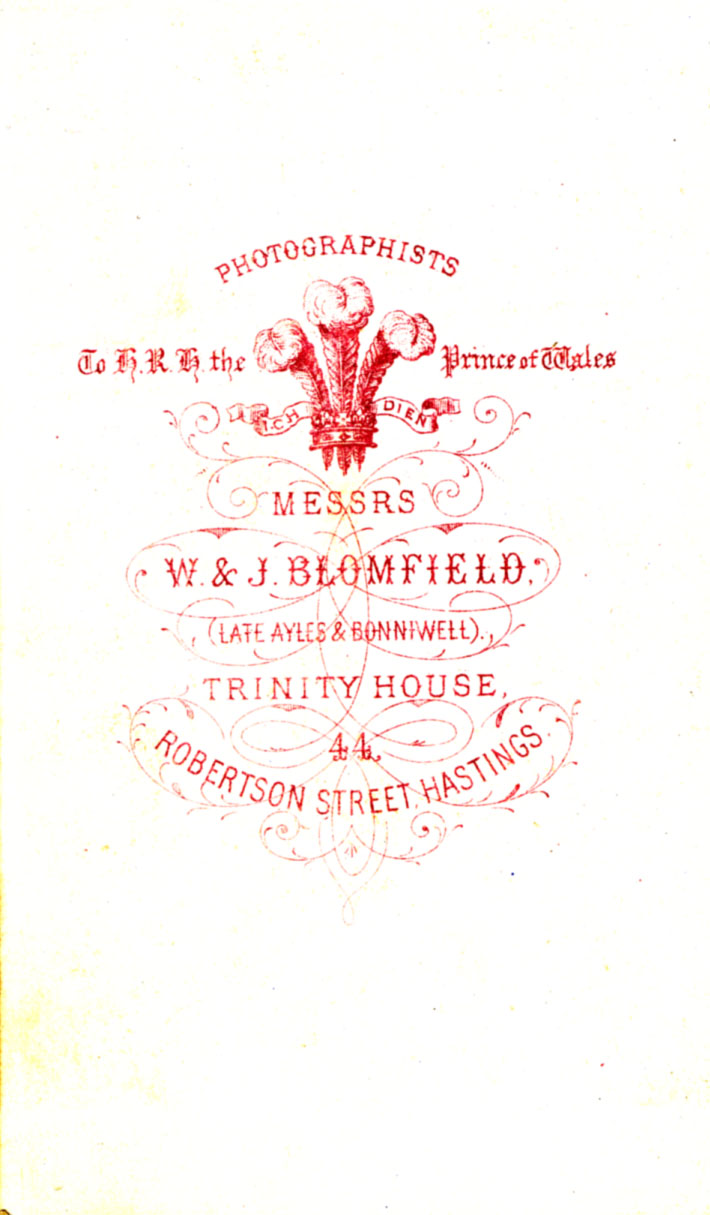
[ABOVE] The trade plate of Messrs W. & J. Blomfield, Trinity House, 44 Robertson Street, Hastings (c1869). The Blomfield brothers had adapted the former trade plate of Ayles & Bonniwell and the latter's claim to be "Photographists to H.R.H. the Prince of Wales" was retained by William and John Blomfield. The brothers also kept the Prince's heraldic badge, featuring three ostrich feathers, to indicate royal patronage. |
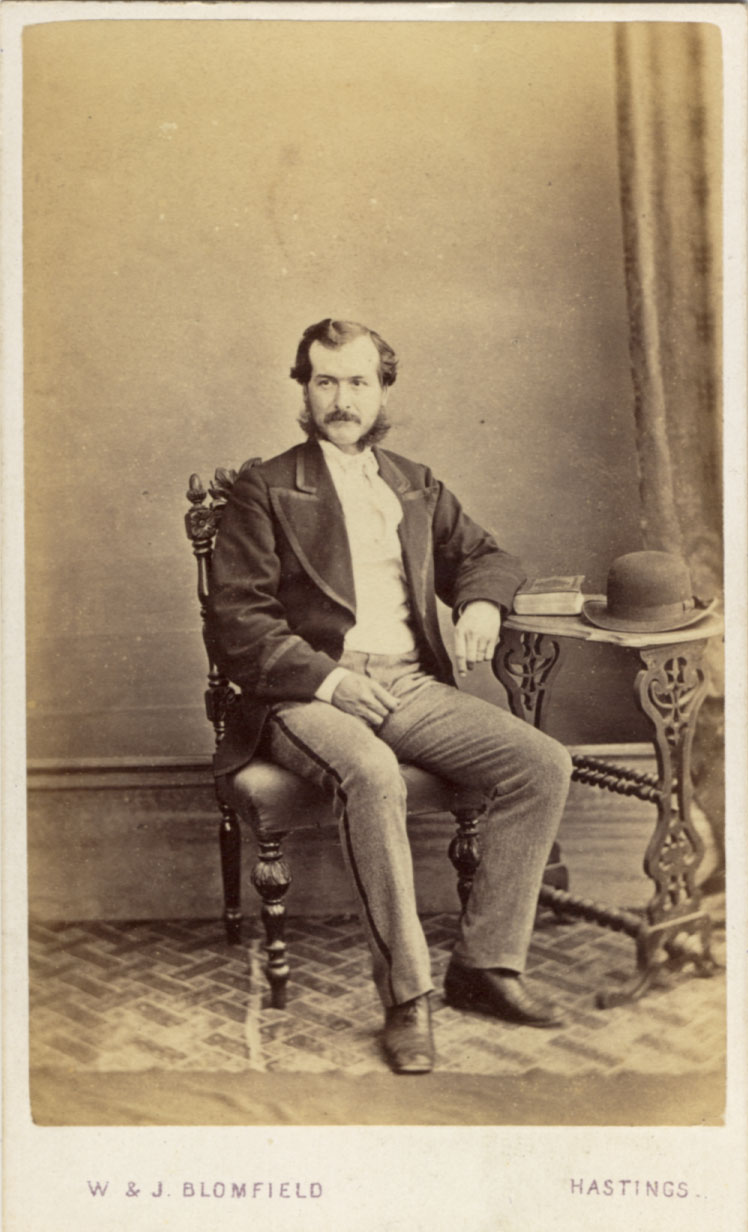
[ABOVE] A carte-de-visite portrait of a seated gentleman, photographed
at the studio of Messrs W. & J. Blomfield, Trinity House, 44
Robertson Street, Hastings (c1869). From 1867 to 1872, John Henry
Blomfield was in partnership with his older brother William Knibb
Blomfield. During this period the Blomfield brothers charged 8 shillings
for a dozen cartes-de-visite and 5 shillings for six.
|
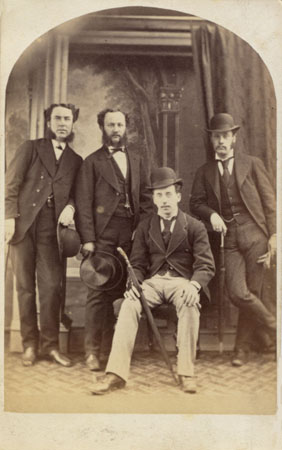
[ABOVE] A carte-de-visite portrait of a group of men photographed at the
studio of Messrs W. & J. Blomfield, Trinity House, 44
Robertson Street, Hastings (c1870). From 1867 to 1872, John Henry Blomfield was in partnership with his older brother William Knibb
Blomfield at the former studio of Ayles & Bonniwell.
|
 |
 |
|
|
|
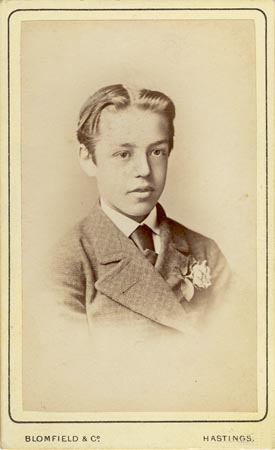
[ABOVE] A carte-de-visite portrait of a boy wearing a flower in his
button-hole, photographed by Blomfield & Co. of Trinity House, Hastings (c1875).
During this period Blomfield & Co. was charging "Half a Guinea"(10s
6d) for a dozen carte-de-visite portraits.
|
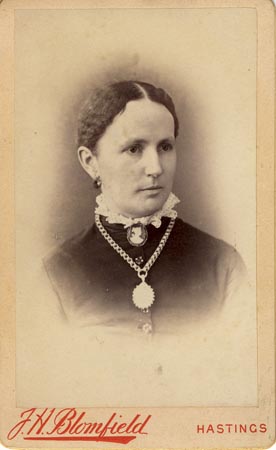
[ABOVE] A carte-de-visite portrait of an unknown woman by John Henry Blomfield of
Hastings, one of a pair depicting a married couple (see the portrait of
the woman's husband on the right). This portrait dates from around 1882 when
the firm of Blomfield & Co. was dissolved and the studio once more
carried the name of John H. Blomfield.
|
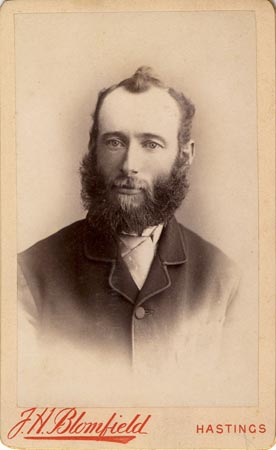
[ABOVE] A carte-de-visite portrait of a bearded man by John Henry Blomfield of
Hastings, one of a pair depicting a married couple (see the portrait of
the man's wife on the left).
This portrait dates from around 1882 when the firm of Blomfield &
Co. was dissolved and the studio once more carried the name of John H.
Blomfield
|
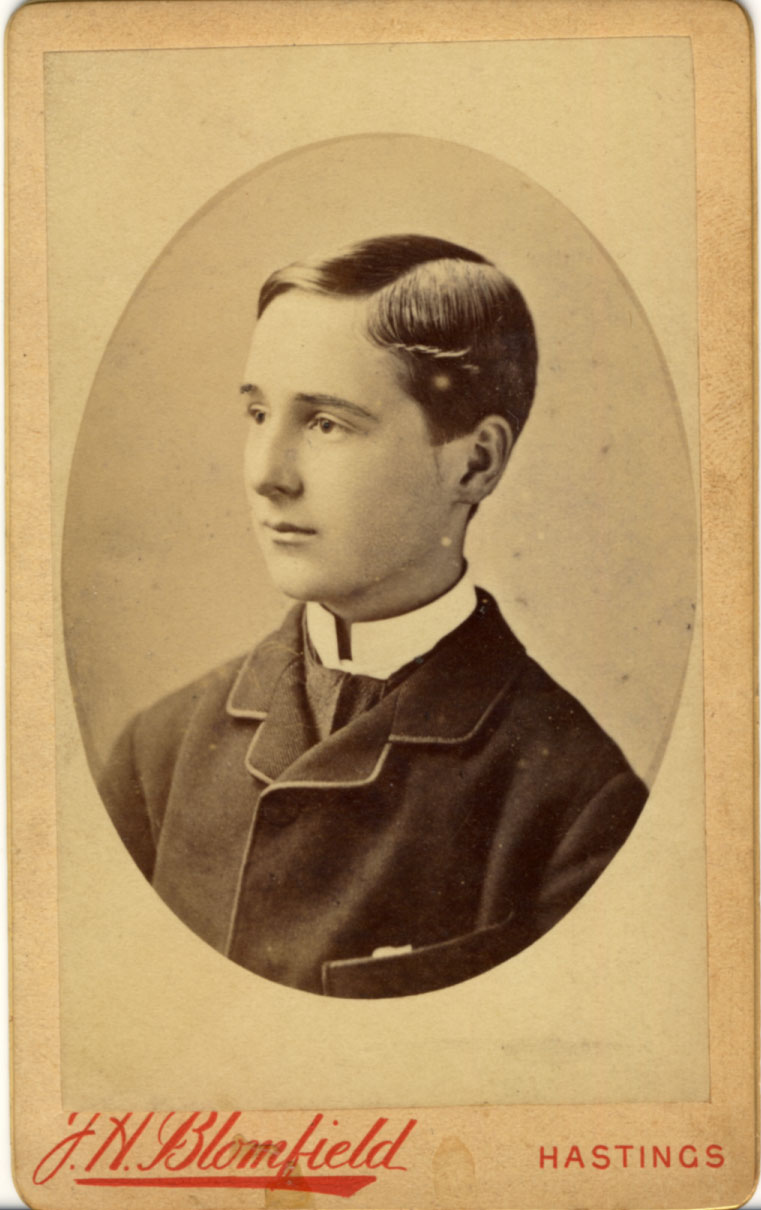
[ABOVE] A carte-de-visite portrait of a young man by J. H. Blomfield of Hastings. Inscribed in ink on the plain back is the name "Constance Clements". Presumably, this carte-de-visite portrait was sent as a personal gift to the lady in question. A young woman named Constance Clements (who was born at St Leonards on Sea, Sussex in 1875) is recorded as a young, unmarried woman of twenty-five and living in Hawkhurst, Kent at the time of the 1901 census. |
|
|
|
 |
|
|
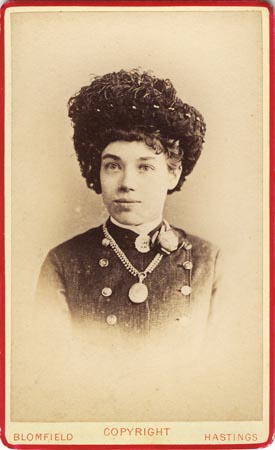
[ABOVE] A carte-de-visite portrait of a young woman in a fancy hat
wearing a medallion, photographed by J. H. Blomfield of 44 Robertson Street, Hastings (c1885).
|
[ABOVE] A Blomfield carte-de-visite portrait of a young couple of diminutive stature (c1888). The couple have been identified as Francis Joseph Flynn (1872-1898) and Millie Edwards (c1874-1919), who toured England as "General & Mrs Mite" between 1884 and 1889. This portrait would be classed as a "celebrity carte-de-visite". When these two small people were photographed in the late 1880s they would have been well-known personalities and a carte-de-visite like this would have been collected alongside portraits of actors and actresses, members of the Royal Family, sporting personalities and other celebrities of the day. Blomfield has copyrighted the portrait to prevent the production of pirated copies. |
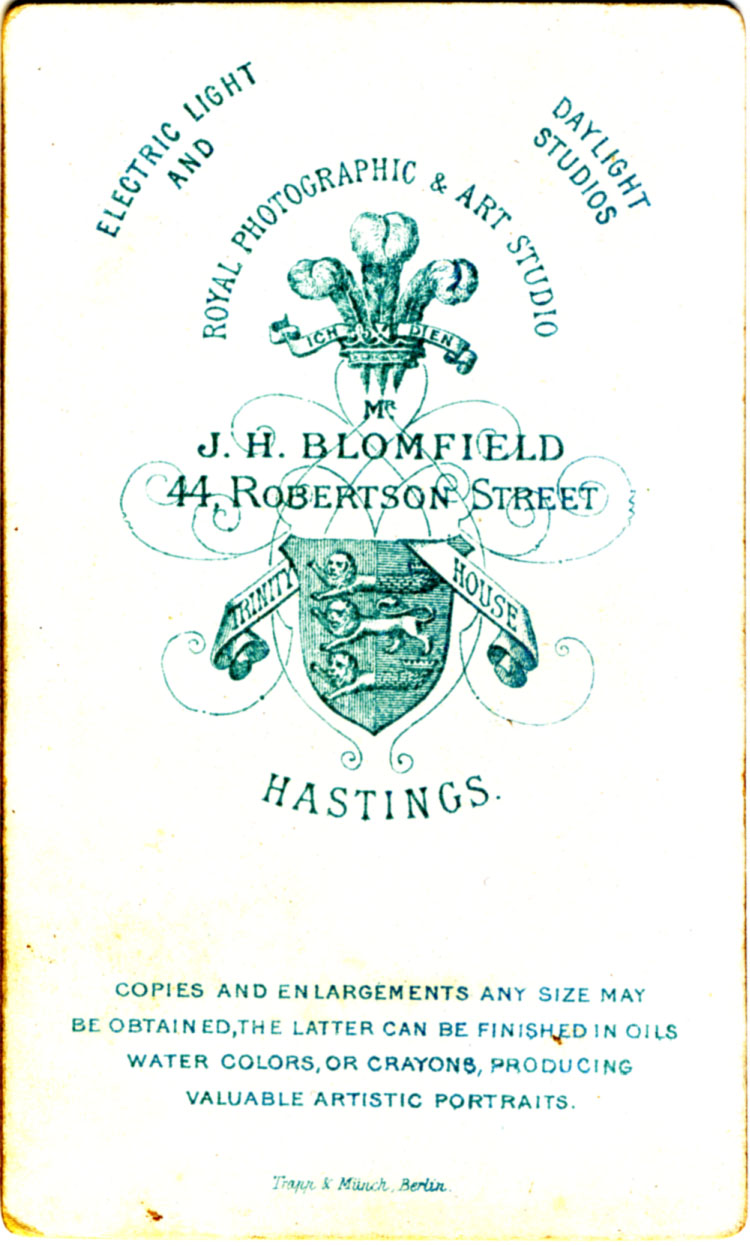
[ABOVE] The reverse of a carte-de-visite produced by J. H. Blomfield of
44 Robertson Street, Hastings (c1888). Twenty years on from the
acquisition of the studio at 44 Robertson Street, J. H. Blomfield has
retained the basic back design first used by Ayles & Bonniwell
around 1865.The publicity featured on this cdv refers to Blomfield's Electric Light and Daylight Studios. Blomfield
introduced electric lighting for "Special Evening Photography" around
1886.
|
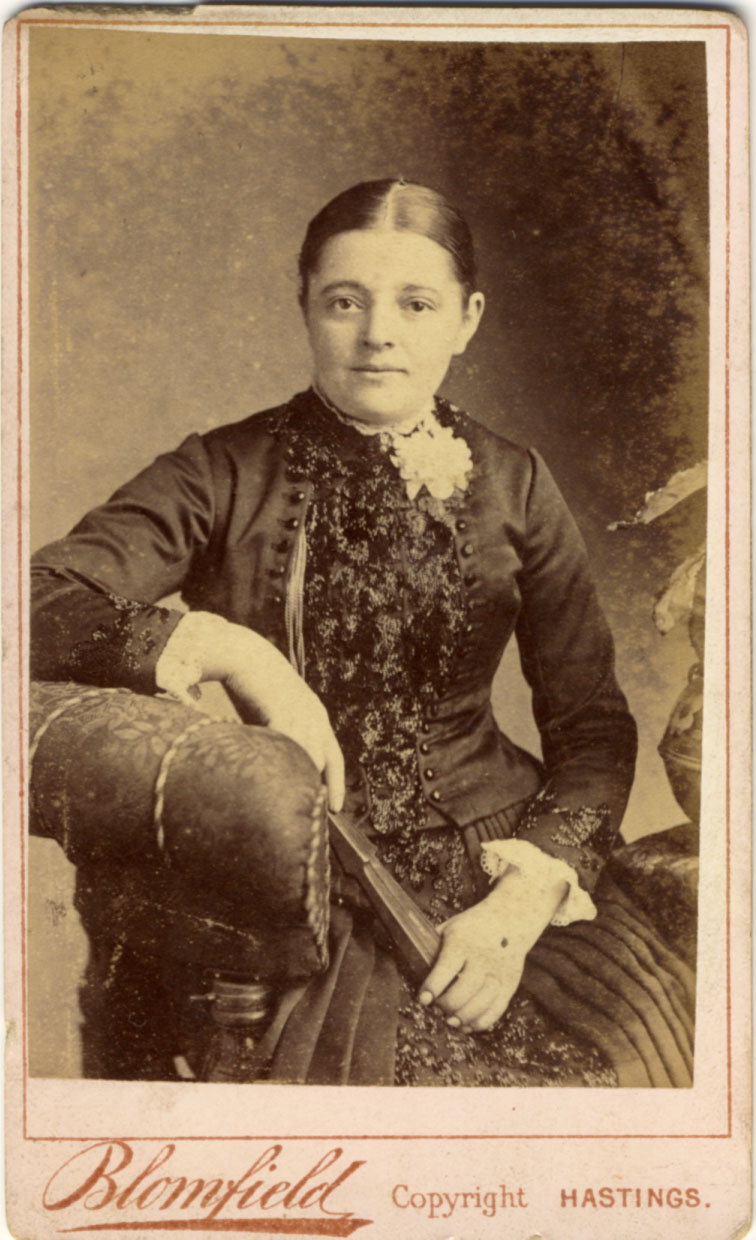
[ABOVE] A carte-de-visite portrait of a seated woman holding a folded fan by J. H. Blomfield of 44 Robertson Street, Hastings (c1885). The back of the carte is inscribed "Mrs Thos. Swingler, Stanion, Thrapstone, Northamptonshire". The woman pictured was Elizabeth Marriott**, who was born in Stanwick, Northamptonshire in 1852. In 1869, Elizabeth married George Drage, with whom she had at least five children. George Drage died in 1878 at the age of 29. In 1879, the twenty-seven year old widow married Thomas Swingler (1852-1904), a baker & grocer of Stanion, Northamptonshire. Mrs Elizabeth Swingler died in 1896 at the age of forty-four. In 1898, two years after the death of his wife Elizabeth, Thomas Swingler married Amy Letitia Stacey (born 1874, Bangor, Caernarvonshire, Wales). |
| ** Thanks to Jonathan Headland for providing family history information relating to Elizabeth Marriott (later Mrs Drage and Mrs Swingler) |
|
|
|
|
|
||||||
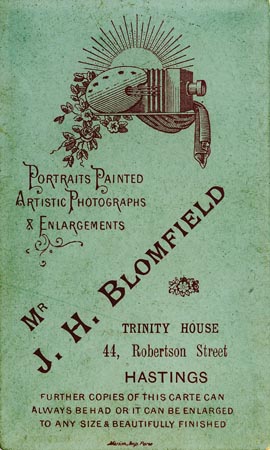
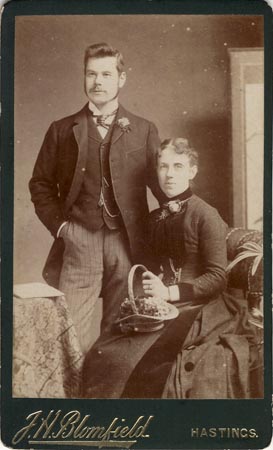
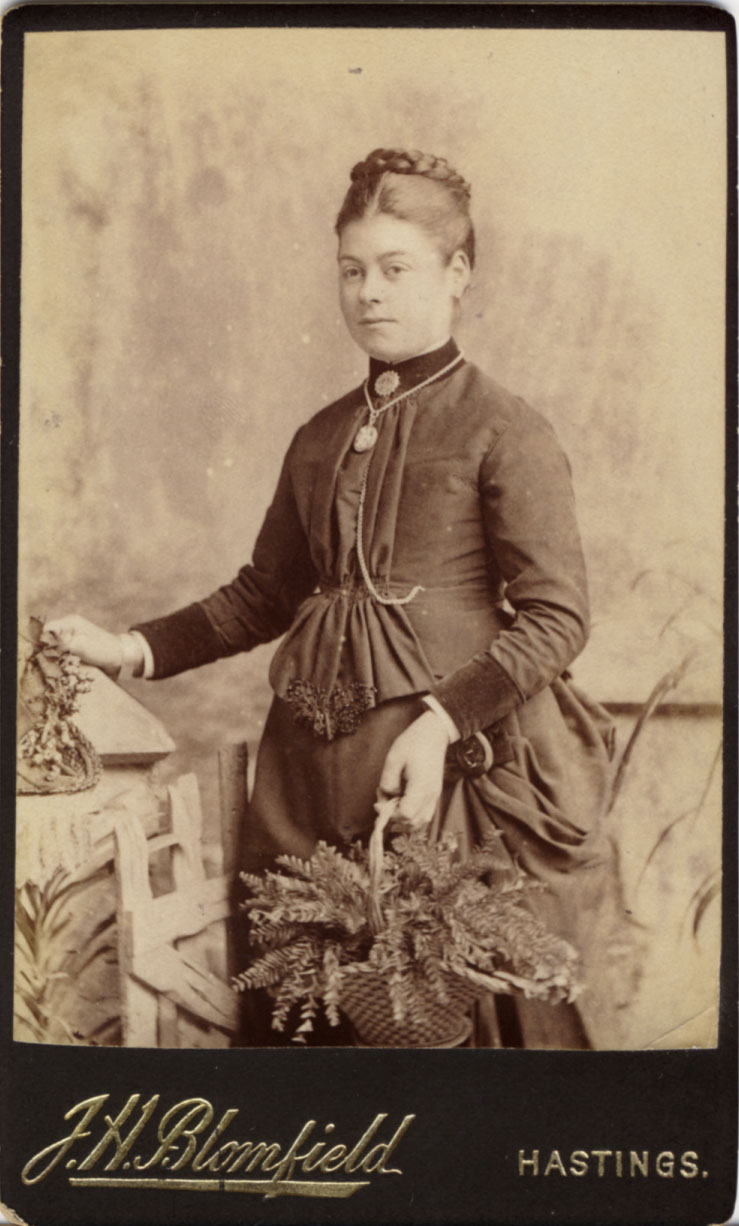
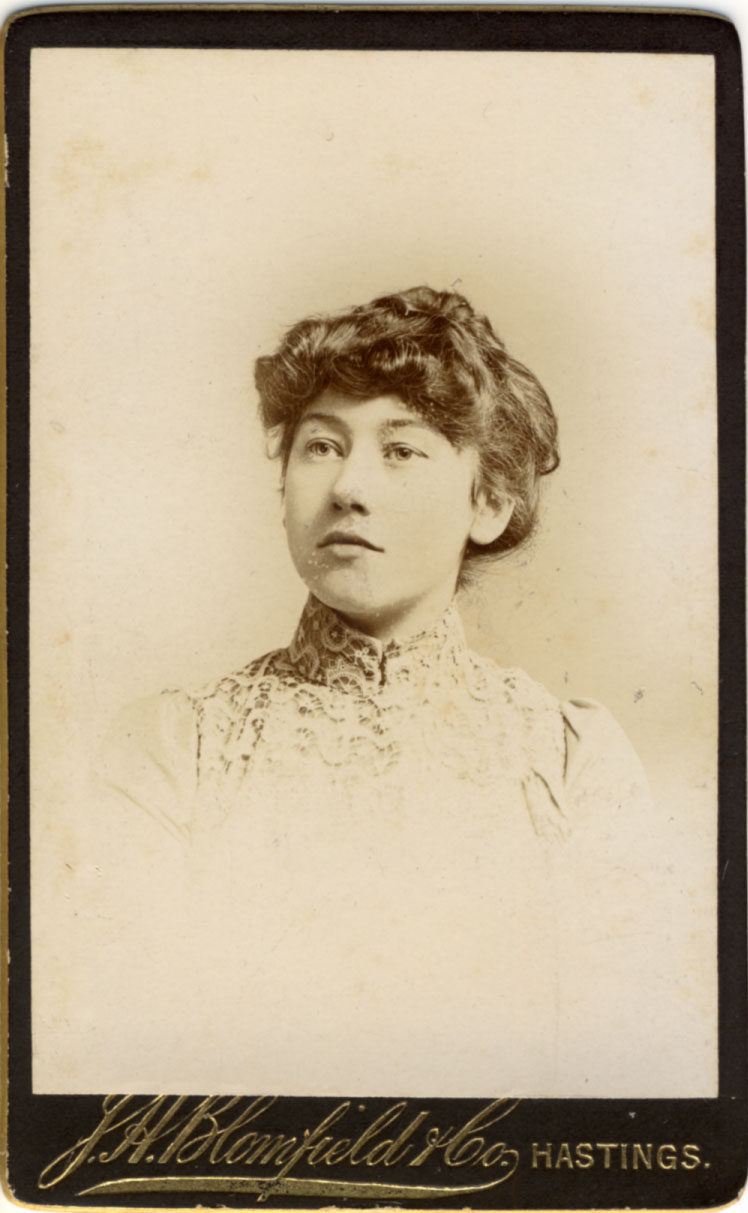
| [ABOVE] The reverse of a carte-de-visite produced by Mr J. H. Blomfield of Trinity House, 44 Robertson Street, Hastings (c1885). The advertising printed on this carte mentions the studio's additional services such as the production of "Artistic Photographs & Enlargements" and the creation of painted portraits based on enlarged photographs. | [ABOVE] A carte-de-visite portrait of a couple, photographed at the studio of John Henry Blomfield, Trinity House, 44 Robertson Street, Hastings (c1890). Around this time, John Blomfield abandoned the white card mounts, which featured the well-established trade plate design incorporating the Prince of Wales' heraldic badge on the reverse. | [ABOVE] A carte-de-visite portrait of a woman holding a basket of ferns (c1890). From 1890 to around 1900, the studio of J. H. Blomfield used black card mounts with plain backs and gold edges. The name of the studio appeared on the front in gold lettering. | [ABOVE] A carte-de-visite vignette portrait of a young woman produced by J. H. Blomfield & Co.(c1900). The vignette portrait utilised a mechanical device to blur the edges of the image to simulate the subtle shading of a pencil or crayon drawing. The vignette portrait was a method of portraiture used by Blomfield in the 1860s, but his studio had the reputation of constantly introducing new photographic styles and techniques. | ||||||
|
|||||||||
|
Click below to go to an account of the photographic career of John Henry Blomfield and William K. Blomfield of Hastings : |