|
||||||||||||||
|
Click here to return to Simkin/Hughes/Kershaw Family webpage |
||||||||||||||
|
||||||||||||||
|
Part Two : Mrs Muriel Simkin 1939-1964 - The Mother |
||||||||||||||
|
|
||||||||||||||
Kershaw/Hughes/Simkin Family Album
|
||||||||||||||
|
Click here to return to Simkin/Hughes/Kershaw Family webpage |
||||||||||||||
|
||||||||||||||
|
Part Two : Mrs Muriel Simkin 1939-1964 - The Mother |
||||||||||||||
|
|
||||||||||||||
|
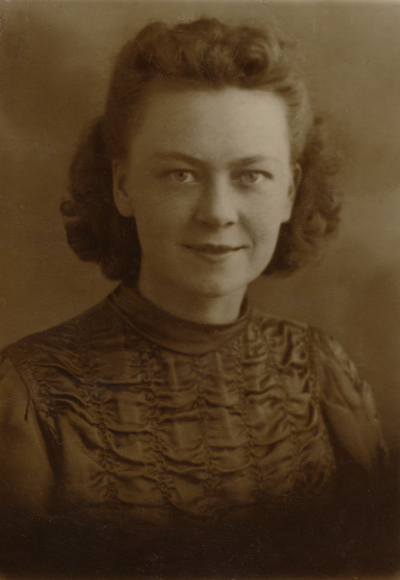
[ABOVE] A studio portrait of Mrs Muriel Simkin, photographed on 22nd March 1949 when Muriel was thirty-four years of age and expecting her third child. When this photograph was taken, Muriel had been married to John Edward ('Ted') Simkin (born 1914, London) for nearly ten years and was the mother of two children, with a third child on the way. |
After her marriage to
John Edward 'Ted' Simkin in August 1939, Mrs
Muriel Simkin set up home with her new husband at 98 Rogers Road,
Dagenham, Essex. At the time of her marriage, Muriel was employed as an
"Examiner and Finisher" at the London tailoring firm of Horne Brothers,
earning 8s 6d a week. Muriel's husband, Ted Simkin, worked as a porter at a
London fish market. Following the outbreak of World War Two in 1939, both Muriel and her husband were called up for war service. Ted Simkin was conscripted into the Royal Artillery on 15th July 1940 and Muriel had to take up war work at the Briggs munitions factory in Dagenham, Essex. During her marriage to Ted Simkin, Muriel gave birth to three children - Patricia Ann Simkin (born on 7th March 1942), John Terence Simkin (born on 25th June 1945) and David Edward Simkin (born on 12th May 1949).
|
|
Muriel's Husband in the Royal Artillery during the Second World War |
|||||||
|
[ABOVE] Ted Simkin photographed by his wife Muriel in 1942 while he was on leave from the army. John Edward Simkin, known as Ted to his friends, was twenty-eight when this photograph was taken.
[ABOVE] Ted Simkin photographed in his back garden by his wife Muriel in 1942 while he was on leave from the army. |
[ABOVE] A group photograph taken of John "Ted" Simkin's Royal Artillery unit while based at "Hell's Corner" during Christmas 1940. Private Ted Simkin is pictured standing in the third row from the front, the fifth soldier in from the left. During the Second World War, Private Ted Simkin manned anti-aircraft guns at Biggin Hill, Rochford, and Dover.
|
||||||
|
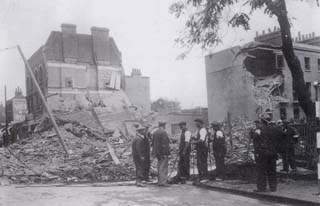
[ABOVE] Bomb damage in World War two. This photograph shows a scene of destruction in Mare Street, Hackney in September 1940. Muriel Simkin worked as a tailoress near Mare Street, Hackney in 1939.
[ABOVE] "Women of Britain - Come into the Factories", a wartime poster issued to encourage women to do 'war work' in factories. Muriel Simkin was compelled to leave her tailoring job to work at the Briggs munitions factory in Dagenham, Essex, in 1940.
[ABOVE] Two women producing RAF ammunition belts at a munitions factory during the Second World War. Muriel Simkin did similar work at the Briggs munitions factory in Dagenham, Essex.
[ABOVE] Civilians take refuge in an London Underground Station during an air raid. Muriel Simkin's three year old cousin was crushed to death at Bethnal Green underground station when a sudden wave of panic caused people to fall down the stairs of the tube station.
[ABOVE] Anderson Shelters. Two families building Anderson shelters in their gardens as protection from air raids.
[ABOVE] "Britain Shall Not Burn - Beat Firebomb Fritz" - a poster issued by the British Government around 1941 to combat the effects of incendiaries or fire bombs. Muriel Simkin's home was targeted by fire bombs, but fortunately none of the incendiary devices went off.
[ABOVE] Jack Hughes, the younger brother of Mrs Muriel Simkin, as he appeared in a hand-tinted photograph taken in Rome, Italy, in 1944. John ('Jack') James Hughes was born in Hackney, East London, on 11th March 1920 and joined the armed forces in 1940. A serving soldier in General Montgomery's Eighth Army, Corporal Jack Hughes fought in North Africa in 1942 and then took part in the Italian Campaign from 1943 until the end of the Second World War. |
[ABOVE] General Bernard Montgomery (centre-right), the Commander of the Eighth Army, inspects troops in North Africa in 1942. Corporal Jack Hughes, Muriel Simkin's younger brother, stands on the far left of the row of soldiers. This photograph later appeared in the Daily Express newspaper, providing evidence to Muriel that her brother Jack was still alive. Jack's family later obtained an original print of the photograph from the Daily Express.
|
|||||||||||||||||||||||||||||||||||||
|
Wartime Family Photos
|
|
|
|
|
|
Ted and Muriel Simkin's Family When Muriel Simkin gave birth to her
first child she was living at 18 Manor Farm Drive, Chingford, Essex.
The baby girl, who was born on 7th March 1942, was christened Patricia
Ann Simkin on 29th September 1942 at The Parish Church of St Peter &
Paul, Chingford.
Muriel and Ted Simkin's second child, a boy named John Terence Simkin, was born on 25th June 1945, six weeks or so after V-E Day which marked the end of the Second World War in Europe. The couple's third child was another son, David Edward Simkin, who was born at the Sun Trap Maternity Home, High Beach, Waltham Holy Cross, Epping, Essex, on 12th May 1949. At the time of David's birth, the Simkin family were living at 42 Bernwell Road, Chingford, Essex. |
||
| [ABOVE] Muriel Simkin, photographed with her first child Patricia Ann Simkin, who was born on 7th March 1942. The photograph was taken in the back garden of the Simkin family home in Manor Farm Drive, Chingford, Essex. |
|
Muriel and 'Ted' Simkin's Three Children |
||
|
|
|
|
| [ABOVE] Patricia Ann Simkin, Ted and Muriel's eldest child, who was born on 7th March 1942. Patricia's friends tended to call her 'Pat', but her immediate family preferred to address her as 'Tricia'. | [ABOVE] John Terence Simkin, Ted and Muriel's second child and eldest son, who was born on 25th June 1945. | [ABOVE] David Edward Simkin, Ted and Muriel's third child and youngest son, who was born on 12th May 1949. |
|
The Simkin Family at the Seaside - Snaps taken on 'days out' to the coast |
|||||||||||||||||||||
|
|||||||||||||||||||||
|
|
|
The Simkin Family in Chingford, Essex During the early 1950s, the Simkin Family lived at 42 Bernwell Road, Chingford Essex. Because of the injuries to his left hand sustained during the Second World War and the subsequent loss of two fingers, Ted Simkin was prevented from returning to his beloved job at Billingsgate Fish Market. After the war, Ted Simkin was forced to take on routine and monotonous work in factories. In 1952, Ted Simkin went into a business partnership with Albert Johnson, the husband of his half-sister Lily White, and set up a shop selling electrical jobs. The electrical goods shop did not flourish and, by 1954, Ted Simkin was working as a 'plastic moulder' at the 'Ever Ready' Electrical Batteries factory in Edmonton, North London. Muriel Simkin, Ted Simkin's wife, was bringing up three children, a girl and two boys, at their home in Chingford. In 1952, Muriel's eldest child, Patricia ('Tricia'), was 10, her eldest son, John, was 7 and her youngest boy, David, was 3 years old. Muriel Simkin's parents, Elizabeth and Thomas Griffiths Hughes also lived in Chingford, as did her younger sister, Stella, who had married George Hume in 1947. In 1952, Mrs Stella Hume (nee Hughes) was the mother of a three year old boy, Keith Hume, who had been born on 16th May 1949, just 4 days after the arrival of Muriel's youngest child, David. On 12th January,1954, Muriel Simkin's father, Thomas Griffiths Hughes died at the age of 73. Mrs 'Nell' Hughes, Muriel's mother, was given the opportunity to move to a property in the newly constructed council estate in the Debden district of Loughton, Essex. Mrs Hughes' son, John 'Jack' Hughes was already living in the main town of Loughton with his wife Eileen and their son Peter Hughes (born 1948).
|
|
 |
|
| [ABOVE] John Simkin, Patricia (Tricia) Simkin and David Simkin photographed in Chingford, Essex, during the celebrations marking the Coronation of Queen Elizabeth II in June 1953. In adult life, all three of Ted and Muriel Simkin's children became staunch republicans. | [ABOVE] Patricia (Tricia) Simkin, John Simkin and David Simkin posing in the centre of this photograph which was taken at the traditional Christmas Party put on by the British Ever Ready Electrical Company (BEREC). 'Ted' Simkin was employed as a "plastic moulder" at the Ever Ready Battery Factory in Edmonton. |
|
The Simkin Family in Debden, Essex |
|||||||||||||||||||||||
|
|
||||||||||||||||||||||
|
|||||||||||||||||||||||
|
|||||||||||||||||||||||
|
||||||
|
The Death of John Edward ('Ted') Simkin (Muriel's husband) in 1956 By the mid-1950s, 'Ted' Simkin, Muriel Simkin's husband, had found employment as a 'plastic moulder' at the 'Ever Ready' Electrical Battery works in Edmonton, North-East London. Ted worked in shifts, sometimes working through the night, returning to his home on the Debden estate to catch up on his sleep during the daytime. Each day he would set off for work on his Vespa motor scooter. 'Ted' Simkin was killed in a road accident in October 1956 at the age of 42. Travelling to work on his motor scooter, Ted Simkin was struck by a lorry in the early hours of the morning of Tuesday,16th October 1956. Ted Simkin did not die at the scene of the collision. The father of three was rushed to hospital, but died as a result of a fractured skull and associated head injuries. Muriel Simkin was left a widow with three children to support - Tricia (Patricia), aged 14, John, aged 11, and 7 year old David.
|
|
|
The Simkin Family Move to Dagenham In 1959, Mrs Muriel Simkin and her three children (Tricia, John and David) left their 3-bedroom house in Debden and moved into a prefabricated bungalow at 106 Gale Street, near Ripple Road, Dagenham, Essex.
|
|
PLEASE NOTE : THIS WEBPAGE IS STILL UNDER CONSTRUCTION
Click here to return to Simkin/Hughes/Kershaw Family webpage