Worthing (Ta-Tu)
Click here to return to Home Page
Professional Photographers in Worthing ( S -T )
Francis Tate - Charles Tidy - George W. Tuft
Francis Tate (born 1852, Lancing, Sussex)
|
Francis Tate was born in Lancing, Sussex, on 13th July 1852, the son of Maria Blowers and George Tate, a gardener from Lancing. George Tate (1814-1902), a native of Lancing, had married Maria Blowers (1809-1891) from Yarmouth, Norfolk on 20th September 1840. A daughter named Charlotte was born about 1847 and her brother Francis arrived around five years later. On 6th April 1874, Francis Tate married Jemima Parker (born 1853, Worthing) at Lancing. Jemima Parker was the daughter of Julia and William Parker, a shoemaker of Worthing. Francis and Jemima Tate settled in London, where Francis worked as a stone mason. In 1877, the couple's only child, Harry Tate, was born in the Kilburn district of London. At the time of the 1881 census, Francis Tate was living in London with his wife Jemima and their three year old son, Harry. In the 1881 census return, Francis Tate is described as a twenty-eight year old "Stone Mason" from Sussex. By the mid 1880s, Francis Tate had returned to Sussex and was operating a stone works in Worthing. A local trade directory, published in 1884, lists Francis Tate as a "monumental mason" at North Street, Worthing. Francis Tate's North Street Stoneworks became a successful business and a firm known as Francis Tate Marbleworks was still supplying stone work-surfaces in Worthing's North Street in 2007. On 4th November 1891,
Jemima Tate, Francis Tate's first wife, died of pulmonary
tuberculosis at the age of 38. The following year, Francis Tate married
Catherine Tucker Judd (born c1863, Paddington, London). The
couple's first child, Chrystobelle Dorothy Tate, was born in
Worthing in 1893 [birth registered in the East Preston District during
the Fourth Quarter of 1893]. A son named Francis George Tate
arrived five years later in 1898 [birth registered in the East Preston
District during the Fourth Quarter of 1898]. Francis and Catherine's
third child, Martin Leslie Tate was born towards the end of 1900
[birth registered in the East Preston District during the Fourth Quarter
of 1900]. |
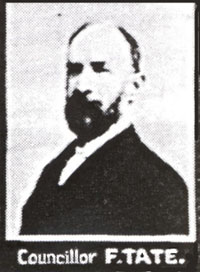
[ABOVE ] A portrait of Francis Tate, photographer, master stonemason and sculptor. [Photograph courtesy of Ray George]
[ABOVE] Francis Tate listed as a professional photographer in Kelly's 1899 Directory of Sussex. |
|
[ABOVE ] A portrait of Charlotte Tate (born c1847, Lancing), a sister of Worthing stonemason and photographer Francis Tate. Charlotte Tate was a school mistress by profession and worked as a teacher in Worthing for over 20 years. This portrait of Charlotte was taken at Walter Gardiner's Broadway Studio in Worthing around 1905. [Photograph courtesy of Ray George] |
[ABOVE ] Francis Tate, pictured with his first wife Jemima and their son Harry. A group portrait by Stuart & Co., Connaught House, 53 Chapel Road, Worthing. (c1886). Mrs Jemima Tate, who was Francis Tate's first wife, died on 4th November 1891 of pulmonary tuberculosis at the age of 38. [Photograph courtesy of Ray George] |
Francis Tate, Photographer
| Francis Tate is listed as a "landscape and monumental photographer"
in local trade directories between 1892 and 1899. However, there is
evidence that Francis Tate was taking photographs in Worthing in the mid
1880s. A photograph of a group of workers employed at Tate's Stone
Works, including Francis Tate's young son Harry, was taken by Francis
Tate around 1885 (see below). This group portrait was probably taken by
Francis Tate for his own pleasure and not for commercial purposes.
Francis Tate is not listed as a professional photographer in Worthing
until around 1892. Long's Worthing Directory, published in 1892,
includes two advertisements for "Francis Tate, Architectural and
Monumental Mason" of Stone Yard, North Street, Worthing. The second,
full-page advertisement for Tate's Stone Yard in Long's 1892 Directory
mentions the fact that Francis Tate also offers "Architectural,
Monumental and Landscape Photography". Although the majority of Francis Tate's photographs were of buildings and monuments, he did occasionally produce group portraits. A photograph taken by Francis Tate in 1893, shows a group of doctors and nurses assembled in the grounds of Richmond House, a temporary fever hospital set up during the Worthing typhoid epidemic. Francis Tate was listed as a "landscape and monumental photographer" in Kelly's Sussex directories up until 1899.
|
![]() [ABOVE] A group portrait by Francis Tate showing the medical staff who were based at Richmond House, Worthing, during the typhoid epidemic of 1893. Richmond House in Tennyson Road was used as a temporary fever hospital throughout the epidemic. The two doctors standing to the left of the group of nurses, have been identified as Dr. Parker and Dr. Edward Opie. [West Sussex County Council Library Service] |
Francis Tate - Stone Mason
[ABOVE ] A photograph taken by Worthing stonemason Francis Tate depicting some of the men and boys employed at Tate's Stoneworks (c1885). The boy on the right of the picture (seated on the wheelbarrow with the painted inscription "TATE'S STONEWORKS, - NORTH ST") is the employer's son Harry Tate, who was born in London in 1877. [Photograph courtesy of Ray George]
[ABOVE] Harry Tate, Francis Tate's son, pictured at work in his father's stone yard in North Street, Worthing (c1885). Harry Tate is shown carving a cross on a memorial gravestone. The provision of cemetery headstones was a speciality of Francis Tate's Stone Works. In 1910, Francis Tate fashioned a marble headstone for the grave of Mrs Cora Crippen (aka Belle Elmore) the victim of the notorious wife murderer Dr Hawley Harvey Crippen. Harry Tate trained as a stone mason under his father, Francis Tate. In 1908, Harry Tate married and settled in West Tarring. From 1908 to 1915, Harry Tate is recorded at 'Melbourne', Highdown Avenue, Highfield Road, West Tarring, near Worthing. [Photograph courtesy of Ray George] |
[ABOVE ] An advertisement for Francis Tate, Architectural and Monumental Mason of Stone Yard, North Street, Worthing, which appeared in Long's Worthing Directory of 1892. The stoneworks in North Street, Worthing were established in 1864. In the 1860s, the proprietor of the stone yard in North Street was Alfred Ovett, a monumental mason. Alfred Ovett was still working as a stone mason in Worthing's North Street at the time of the 1881 census, but died six days after the census return was completed. In 1881, Francis Tate was employed as a stone mason in London, but sometime in the early 1880s he returned to Sussex and took possession of the stone works in North Street. Kelly's Sussex Directory of 1884 lists Francis Tate as a monumental mason in North Street, Worthing. Subsequent entries in local trade directories describe Francis Tate variously as a monumental mason, sculptor and general stone mason who worked in granite, marble, slate and stone. Around 1890, Francis Tate added a marble works to his stone yard in North Street, Worthing. Tate called this addition to his stone-working business, The Carrara Marble Works, named after the world famous white marble quarried in the Massa-Carrara region of Italy, north-west of Florence. ( Carrara marble has been used to make monuments and statuary since ancient times. The Pantheon and Trajan's Column was made from this marble. The Renaissance sculptor Michelangelo carved his giant figure of David from Carrara marble. London's famous Marble Arch is a monument constructed from white Carrara marble ). Francis Tate's Stone Yard and Carrara Marble Works in North Street produced memorials and cemetery monuments over a period of forty years or more. In the 1890s, Tate's Stone Yard was engaged mainly in the production of graveyard memorials in the form of head-stones, crosses, stone tablets and tombs. An 1892 advertisement for Tate's Stone Yard declared that Francis Tate's work could "be seen in almost every Churchyard within a radius of twelve miles of Worthing". An invoice issued in 1895 gives the cost of one of Tate's cemetery memorials as £34 11s 6d. After 1918, Francis Tate's company produced a number of memorials to commemorate those who had lost their lives during the First World War. In 1919, Francis Tate & Co. produced the Angmering War Memorial, a monument made from Portland stone. The following year, Tate's Stone Yard provided an inscribed pedestal of Portland stone for the life-size bronze figure which surmounted the Worthing War Memorial. Francis Tate charged £194 6s 0d. for the production and erection of the memorial cross at Angmering and was paid £400 for his work on the Worthing War Memorial. [ABOVE] The unveiling of the Worthing War Memorial on 11th April 1921. Francis Tate's company provided the Portland stone pedestal for the Worthing War Memorial. |
|
||
|
|
|
Acknowledgements |
| I am indebted to Ray George, a great grandson of Francis Tate, who has kindly provided photographs relating to Francis Tate's family. Ray George's grandfather was Harry Tate, the eldest son of Francis Tate. |
Click here to return to Home
Page