Worthing Photographers / Bo-Br
Click here to return to Home Page
Professional Photographers in Worthing (Bo-Br)
Harry Booth - William Borrill- Walter Charles Bristow - Mrs Eliza Bristow - Otto Brown
Harry Booth (born c1854, Bradford, Yorkshire)
| 1891 Census : Traveller's
Rest, Clifton Road, WORTHING Harry Booth Photographer age 37 |
William Borrill (born c1858, London, Middlesex)
| 1881 Census : 9 Chapel Road,
WORTHING William H. Borrill Photographer age 23 |
The Studio of W. C. Bristow
Walter Charles Bristow (1861-1896)
Mrs Eliza Bristow (1869-1935)
![]()
[ABOVE] Carte-de-visite portrait of a young man by W. C. Bristow, 2 South Street, Worthing (c1894) |
Walter Charles Bristow (1861-1896) Walter Charles Bristow was born in Margate, Kent in 1861 [ birth registered in the District of Thanet during the Second Quarter of 1861]. His origins are obscure but Walter Bristow might have been related to William Bristow (born c1857) and Edward Bristow (born c1858), two brothers who had also been born in Margate in the same period. In 1858, there were two men named Bristow who were running lodging houses in Margate - a Mr Bristow of Addington Street and Mr Edward Bristow who had a lodging house in Margate's High Street. The name "Walter Bristow" does not appear in the 1881 census index. This could mean that Walter was out of the country when the census was taken or that his name has been incorrectly transcribed. By around 1889, Walter Bristow was working as a photographer in Worthing. In the commercial section of Kelly's 1890 Directory of Sussex, Walter Charles Bristow is listed as a photographer at 2 South Street, Worthing. The 1891 census records Walter C. Bristow lodging in South Street, Worthing at the house of shopkeeper Joseph Reavell (born 1846, Stepney, London). Joseph Reavell ran a greengrocery business at No 2 South Street and he apparently allowed Walter to use part of the business premises as a photographic portrait studio. Walter C. Bristow is described on the census return as a "Photographer (employer)", aged 29. One of Walter Bristow's employees at his South Street studio might have been twenty-one year old Eliza Gee (born 1869, Chatteris, Cambridge), the daughter of Reverend Henry Gee, a former missionary and minister of religion. At the time of the 1891 census, Eliza Gee was living at her parents' house in Chatteris, Cambridgeshire, possibly making arrangements for her forthcoming wedding. On the census return Eliza Gee is entered as a "Photographer", aged 21. A few weeks after the census was taken, Walter Charles Bristow married Eliza Gee in Chatteris [ marriage registered in the District of North Witchford, Cambridgeshire, during the Second Quarter of 1891]. The couple returned to Worthing and set up home at a house called 'Kenilworth' at 26 Wenban Road, Worthing.
[ABOVE] A photograph showing South Street, Worthing in the early 1900s. Worthing's Old Town Hall can be seen in the distance. |
![]() [ABOVE] A portrait of Eliza Gee (c1890). The daughter of Henry Gee, a Christian missionary and Independent Church minister, Eliza was born in Chatteris, Cambridgeshire in 1869. Eliza trained as a photographer and in 1891 she married the Worthing photographer Walter Charles Bristow. [PHOTO: Courtesy of Carol Graham ]
[ABOVE] Milton Mount College, near Gravesend, Kent, where Eliza Gee was educated in the 1880s. |
Mrs Eliza Bristow ( born 1869, Chatteris, Cambridgeshire) Eliza Gee, who became Mrs Eliza Bristow in 1891, was the daughter of Mary and Henry Gee (1834-1901), a former missionary and minister of religion. Eliza's father, Henry Gee, was born in Woburn, Bedfordshire in 1834, the son Thomas and Frances Gee. (Henry Gee was baptised in Woburn on 24th October 1835). On 7th September 1859, Henry Gee married Mary Burr (born 1842, Kempston, Bedfordshire) at the Bunyan Meeting House, Bedford. After their marriage, Henry and Mary Gee set sail for Samoa in the South Pacific to carry out Christian missionary work. Henry and Mary Gee began their work on the Samoan island of Savai'i, where their first child, Mary, was born around 1861. A son, named William Gee, was born about 1863 on the neighbouring island of Upolu. On their return from their missionary work in Samoa, Henry and Mary Gee, together with their two young children, came back to Bedfordshire. The couple's third child, Helen Frances Gee was born in Mary Gee's native village of Kempston in 1864. The Gee family then settled in Henry's home village of Woburn, where his next two daughters were born - Annie Maria (born 1866) and Lilian Lizzie (born 1867). By 1869, Reverend Gee and his family had moved to Chatteris, Cambridgeshire, where Henry had been appointed minister to the Independent Chapel in Mill End. There were at least five more additions to the Gee family in Chatteris - Eliza (born 1869), Amy (born 1872), Thomas John (born 1874), Arthur (born c1876) and Charles Rowland Gee (born 1878). When the 1881 census was taken, Rev. Henry Gee, his wife Mary and six of their ten children were living at the family home in Mill Street, Chatteris. Henry Gee is described on the census return as a "Disabled Missionary" with "no occuation", aged 47. Henry's wife Mary, aged 38, gives her place of birth as Kimbolton, Bedfordshire. Five of the Gee children are listed as scholars but the eldest child at home, fifteen year old Annie Maria Gee, is described as a "minister's daughter". Eliza Gee was the third eldest daughter of Mary and Rev. Henry Gee. Eliza had been born in Chatteris in 1869 [birth registered in the North Witchford district of Cambridgeshire during the Second Quarter of 1869]. Eliza was sent away to Milton Mount College, a girls' boarding school near Gravesend in Kent. Milton Mount College had been established in 1871 to provide education "for the daughters of Congregational ministers". Eliza Gee was one of the 150 girls boarding at Milton Mount College, Parrock Road, Milton, when the 1881 census was taken on the evening of 3rd April, 1881. At Milton Mount College, Eliza would have studied Mathematics, Arithmetic, History, Geography, Latin, German and Music. The 1881 census return lists a "Teacher of Writing" and a "Teacher of Needlework" but there is no mention of an instructor in Art or a Science teacher. Nevertheless, even without a grounding in art or chemistry, Eliza Gee chose a career in photography and when the next census was taken on 5th April 1891, she is recorded as a twenty-one year old "Photographer". There is a possibility that Eliza Gee was employed as an assistant to the Worthing photographer Walter Charles Bristow before their marriage in the Spring of 1891 [marriage registered in the District of North Witchford, Cambridgeshire, during the Second Quarter of 1891], but it is certain that she worked alongside Walter Bristow in his South Street photographic studio between 1891 and 1895.
|
|
Family Life After his marriage to Eliza Gee, Walter Bristow could not continue to lodge at 2 South Street with Joseph and Louisa Reavell, the greengrocers who also shared their business premises with the photographer. Joseph and Louisa Reavell had a boy and girl of their own and there was no space for any additional children. By the time Eliza Bristow gave birth to their first child - a boy named Leonard Walter Bristow - in the Second Quarter of 1892, Walter Bristow had found a house called 'Kenilworth' at 26 Wenban Road, Worthing. The couple's second child, Winifred Margaret Bristow was born in 1894 [ birth registered in the East Preston District during the Second Quarter of 1894].
|
|
The Worthing Studios of W. C. Bristow
![]() [ABOVE] A Cabinet portrait of a young woman by W. C. Bristow, 2 South Street, Worthing (c1892). |
![]() [ABOVE] The reverse of Cabinet portrait by W. C. Bristow, 2 South Street, Worthing (c1895). |
![]() [ABOVE] The reverse of Cabinet portrait by W. C. Bristow, 19 Chapel Road, Worthing (c1896) |
![]() [ABOVE] The location of W. C. Bristow's two main studios - 2 South Street and 19 Chapel Road marked on a modern map of Worthing. |
The Studio of W. C. Bristow at 19 Chapel Road, Worthing
![]() [ABOVE] A portrait of Mrs Eliza Bristow (c1910). Born Eliza Gee at Chatteris, Cambridgeshire in 1869, she married the Worthing photographer Walter Charles Bristow in 1891. After her husband's death in 1896, Mrs Bristow continued to work as a photographer in Worthing up to her own death in 1935. [PHOTO: Courtesy of Carol Graham ] |
Around 1895, after five
years at 2 South Street, Walter Bristow opened a second studio in
Worthing at premises in Crescent Road. Shortly afterwards, the W.
C. Bristow studio in South Street was closed and a new studio opened at
19 Chapel Road, Worthing. Walter Bristow was at this time suffering from a wasting disease associated with pulmonary tuberculosis and it is likely that his wife Eliza was taking an increasingly active role in her husband's business. Walter Charles Bristow died at 19 Chapel Road, Worthing on 2nd March 1896 at the age of 34. The cause of death was given as "Phthisis" (wasting disease) and the death certificate indicates that Walter had been suffering from the disease over the previous three and a half years. Mrs Eliza Bristow, an experienced photographer, took over the running of the studio in Chapel Road, but continued to trade in Worthing under the name "W. C. Bristow". At the time of her husband's death, Eliza Bristow was only 26 years of age with two young children under the age of four. Eliza clearly needed assistance in the studio and she turned to her family for support. Before very long, the young widow was joined by her younger brother, Charles Rowland Gee (born 1878, Chatteris, Cambs.), who had arrived in Worthing to help Eliza operate the studio at 19 Chapel Road. When the 1901 census was taken on 31st March 1901, Mrs Bristow, her two children (Leonard, aged 8, and Winifred, aged 7), together with her brother, Charles Gee, were recorded at 19 Chapel Road, Worthing. Mrs Eliza Bristow is entered on the return as a thirty-one year old widow and she is described as a "Photographic Artist (Employer; at Home)". Charles R. Gee is listed on the return as a "Photographer's Assistant", aged 22. Charles Gee worked in his sister's studio for a number of years before returning to his home town of Chatteris, where he ran a photographic studio during the First World War. By 1916, the year Charles R. Gee is recorded as a photographer in Chatteris, Eliza's son Leonard was twenty-three and her daughter Winifred was twenty-two. Eliza Bristow's studio in Chapel Road had carried the name of her late husband until about 1910. When Kelly's Directory of Sussex was published at the beginning of 1911, it is "Mrs W. C. Bristow" who is listed as the photographer at 19 Chapel Road, Worthing. Mrs Bristow was still listed as the proprietor of the Chapel Road studio when the 1918 edition of Kelly's Sussex Directory was issued. Around 1920, Mrs Eliza Bristow moved to 34 Teville Road, Worthing, where she carried on her photography business until her death in 1935. |
![]() [ABOVE] Carte-de-visite portrait of a young man taken at the studio of W. C. Bristow, at 19 Chapel Road, Worthing (c1898) |
![]() [ABOVE] A family group portrait taken at the studio of Mrs Bristow at 19 Chapel Road, Worthing (c1915). [ Proprietor : Mrs Eliza Bristow]. This postcard portrait is blind-stamped "Bristow, Worthing" |
![]() [ABOVE] Postcard portrait of a woman taken at Bristow's studio at 19 Chapel Road, Worthing (c1910) [ Proprietor : Mrs Eliza Bristow] . Blind-stamped "Bristow, Worthing" |
[ABOVE] Carte-de-visite portrait of a woman taken at the studio of W. C. Bristow, at 19 Chapel Road, Worthing (c1902) [ Proprietor : Mrs Eliza Bristow]. By 1907, the carte-de-visite was virtually obsolete and the picture postcard had become the most popular format for portrait photography. [ See the two examples of Mrs Bristow's postcard portraits on the left ]. |
|
To view examples of the photographic work produced at the studios of W. C. Bristow of Worthing, click on the following links : |
|
Acknowledgements |
| Thanks to Carol Graham for providing details of Eliza Gee's family history and for permission to use the two portrait photographs of Eliza Gee (Mrs Eliza Bristow). |
Otto Brown (born c1882, Long Sutton, Somerset)
| Otto Brown was born around 1882
in Long Sutton, Somerset, the second son of Sarah and Charles Brown, a
beer seller and grocer. Charles Brown, Otto's father, was born in
Long Sutton in 1839. When the 1881 census was taken, Charles Brown was
an unmarried man of forty-one, earning a living by selling beer from a
licensed, "outdoor" beer house. ( Brown's business was described as an
"Outdoor Licensed Beer House" because the beer had to be "consumed off
the premises"). Charles Brown also sold groceries from his shop and in
the commercial listings in local trade directories, he is entered as a
"grocer & beer retailer". Shortly after the 1881 census was taken,
Charles Brown married Sarah, a local woman in her early twenties. The
couple's first child, Charles Brown junior, was born around 1881.
Otto Brown was born in the village of Long Sutton the following
year. Charles and Sarah Brown's third child, Herbert Brown, was
born in the village in 1884 [ birth registered in the Langport district
of Somerset during 2nd Quarter of 1884]. Two more boys were born in Long
Sutton before the Brown family moved to Pokesdown in Hampshire -
Alwyne Duncan Brown (born 1889, Long Sutton) and George Leonard
Brown (born 1893, Long Sutton). By 1897, Charles Brown and his
family had left Long Sutton. The 1901 census records Charles Brown and his family at 25 Wickham Road, Pokesdown, near Christchurch in Hampshire. Sixty-one year old Charles Brown was now employed as a "Gardener (Domestic)". Otto Brown is described on the census return as an "Artist & Photographer", aged 18. The census enumerator notes that Otto Brown was a self-employed photographer ("own account") and was working from the home address in Wickham Road. By the Spring of 1905, Otto Brown was in Sussex. (Otto's marriage was registered in the Steyning district of Sussex during the 2nd Quarter of 1905). Around 1905, Otto Brown entered into a business partnership with Leon Balk (born 1878, Taurage, Lithuania), a photographer who had been operating a photographic studio in Eastbourne, Sussex, since 1903. The firm of Balk & Brown operated at studio at 116 Langney Road, Eastbourne and another at 69 Devonshire Road, Bexhill-on-Sea. It appears that Otto Brown was based at the Bexhill studio in Devonshire Road, while Leon Balk remained in Eastbourne. Around 1906, Otto Brown left Bexhill and established his own studio at 2 Chapel Road, Worthing. Leon Balk took over the Bexhill studio previously run by Brown when the partnership was dissolved in 1906 and he remained in business at 69a Devonshire Road until 1915. (See Leon Balk) |
[ABOVE] Carte-de-visite portrait of a woman taken at the studio of Otto Brown, 2 Chapel Road, Worthing (c1907)
|
|
[ABOVE] Portrait of a woman and her three children by Otto Brown, 2 Chapel Road, Worthing (c1908) |
[ABOVE] Portrait of a woman with a collar and tie and wearing a straw boater, photographed by Otto Brown of Worthing (c1910) |
|
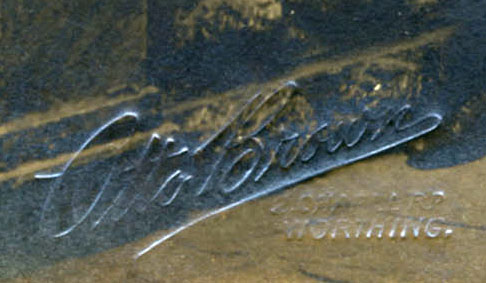
[ABOVE] Portrait of a woman in a dark dress, a postcard portrait by Otto Brown of Worthing (c1910). Otto Brown's trade plate is blind-stamped in the lower right-hand corner.
[ABOVE] The blind stamp of Otto Brown, photographer, 2 Chapel Road, Worthing. |
Otto Brown's Postcard Portraits After 1910, most of the portraits taken at Otto Brown's were in the popular postcard format. Otto Brown's portrait studio at 2 Chapel Road, Worthing was equipped with a range of elaborate sets and painted backdrops. Customers at his studio were posed in front hand-painted backgrounds that simulated smart sitting rooms, leafy gardens and a beach scene with waves crashing on a seashore.
Otto Brown after 1911 Otto Brown operated his photographic portrait studio at 2 Chapel Road, Worthing for over thirty years. After Carl Adolf Seebold (1873-1951), a Swiss-born impresario, opened The Kursaal entertainment complex on Worthing's seafront in 1911, Otto Brown arranged for a photographic studio to be attached to this popular seaside attraction. The Kursaal was an entertainment centre that comprised of a roller-skating rink, a cinema, licensed refreshment rooms, a bazaar, an exhibition hall and a covered ornamental garden used for concerts. Geoffrey Godden, in his book "Collecting Picture Postcards"*, notes that Otto Brown "had a well-known photographic studio in the Kursaal complex, and was therefore well placed to take photographs of the many bands, including the Royal Navy Ladies Orchestra, concert parties and other entertainers who performed at the Kursaal and at the Winter Gardens, just behind the main building." Around 1911, Otto Brown photographed a concert party known as "The Comedy Comets" in the Kursaal Gardens. A few years later, Brown produced a series of photographs of the "Worthing Whimsies", a group of entertainers that succeeded the Comets at the Kursaal. Otto Brown appears to have vacated the Kursaal studio on Marine Parade around the time Seebold changed the name of his cinema and entertainment hall from the Kursaal to "The Dome" in 1915. (The German sounding name of the Kursaal was jettisoned when anti-German feelings were at their height during the First World War). Otto Brown continued to operate his portrait studio in Chapel Road up until the Second World War. Kelly's 1938 Directory of Sussex still lists Otto Brown at 2 Chapel Road, Worthing, some thirty years after his arrival in Worthing in 1906. * Collecting Picture Postcards by Geoffrey Godden (Phillimore & Co. Ltd.,1996) page 129. |
Otto Brown at The Kursaal
|
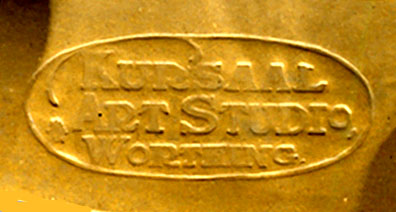
[ABOVE] The trade plate of the "Kursaal Art Studio, Worthing", blind-stamped on a postcard portrait, probably taken by Otto Brown around 1914. Otto Brown operated a photographic studio attached to C. A. Seebold's Kursaal in Marine Parade from around 1911 to 1915 (see below). [RIGHT] A portrait of Carl Adolf Seebold (1873-1951). Seebold was born in Zurich, Switzerland in 1873 and was from a family of musicians. By the 1890s, Seebold and his family were living in England. In 1898, Carl Adolf Seebold married a Lancashire lass named Harriet Crawshaw and settled in Rochdale, Lancashire, where he worked as a musician. By 1902, Seebold was in the Essex seaside resort of Southend-on-Sea, where he ran a theatre and put on musical concerts. Seebold arrived in Worthing in 1904 and became the Manager of the New Theatre Royal in Bath Place. In 1909, Seebold started work on The Kursaal, an entertainment complex on Worthing's seafront. In 1910, Seebold put on musical entertainments in the Kursaal Pleasure Gardens and in 1911, the Kursaal building itself was opened to the public. |
![]() [ABOVE] A portrait of Carl Adolf Seebold ,taken from a Theatre Royal programme cover (c1909) |
|
[ABOVE] A picture postcard showing The Kursaal (The Dome), Marine Parade, Worthing (c1914). Otto Brown operated a photographic studio at the Kursaal during the First World War period. The Kursaal, an entertainment complex on Worthing's seafront was built in 1910 and opened to the public the following year. The Kursaal included a roller skating rink, an exhibition hall, a cinema, refreshment rooms, and a covered garden for outdoor entertainment. Following the outbreak of the First World War, the German-sounding name of the Kursaal was changed to "The Dome" in 1915. [RIGHT] This detail from the same postcard shows the advertising for "OTTO BROWN, ART PHOTOGRAPHER" on the awning of the Kursaal Bazaar. |
|
|
[ABOVE] A picture postcard by Otto Brown, entitled "C. Adolf Seebold's Worthing Whimsies, 1914". Carl Adolf Seebold (born 1873, Zurich) was a Swiss-born impresario who arrived in Worthing in 1904, after working as a musician in Rochdale and running a theatre in Southend-on-Sea. In 1911, Seebold opened the Kursaal, an entertainment complex on Worthing's seafront. Carl Adolf Seebold mounted musical entertainments in the covered ornamental garden at the rear of the Kursaal. Entertainers who performed at the Kursaal, such as the "Worthing Whimsies" (above), were photographed by Otto Brown, who had a studio attached to the Kursaal Bazaar. |
![]() [ABOVE] Another picture postcard by Otto Brown featuring the "Worthing Whimsies", a concert party that performed at Carl Adolf Seebold's Kursaal in Worthing ( Postcard dated 1914). |
Otto Brown on Location
![]() [ABOVE] A picture postcard by Otto Brown, entitled "Worthing Pier Washed Away, March 23rd 1913". In addition to his studio portrait work in his Chapel Road studio and the publicity shots of entertainers, photographed in the grounds of The Kursaal, Otto Brown also ventured out with his camera to record events in and around Worthing. This picture postcard by Otto Brown shows the destruction caused to Worthing Pier during the Great Storm of 1913. |
|
Click on the link below to view a selection of Otto Brown's postcard portraits : |
|
Acknowledgements |
| Thanks to Geoffrey Godden, author of the book "Collecting Picture Postcards" (Phillimore & Co.,1996), which focuses on the picture postcards produced in Worthing during the first two decades of the twentieth century. |