Beauford Richard
Professional Photographers in Hastings ( B )
Richard Beauford : Photographer in Hastings & St Leonards-on-Sea from 1849 to 1853
Click here to return to Home Page
![]() |
|
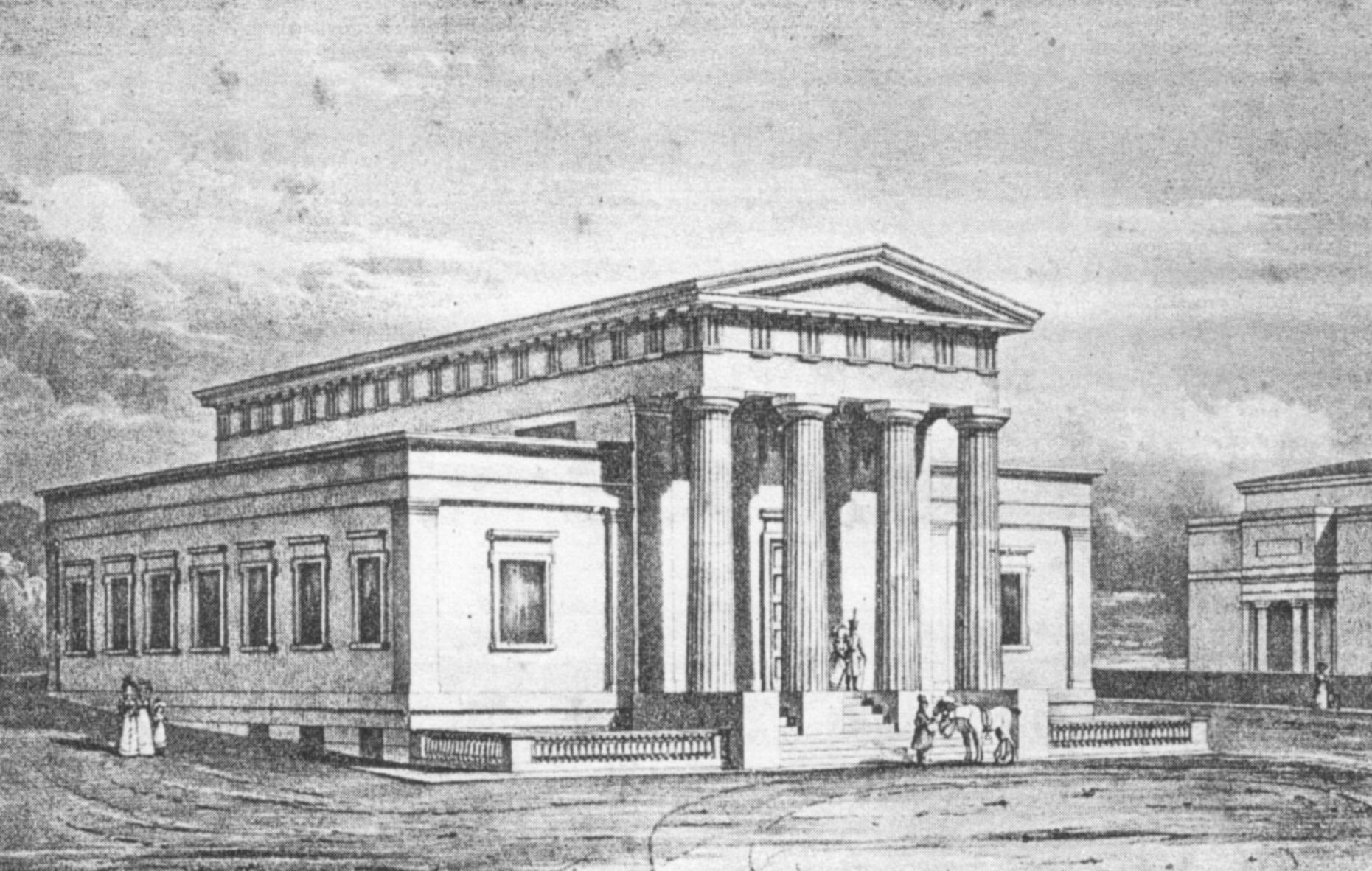
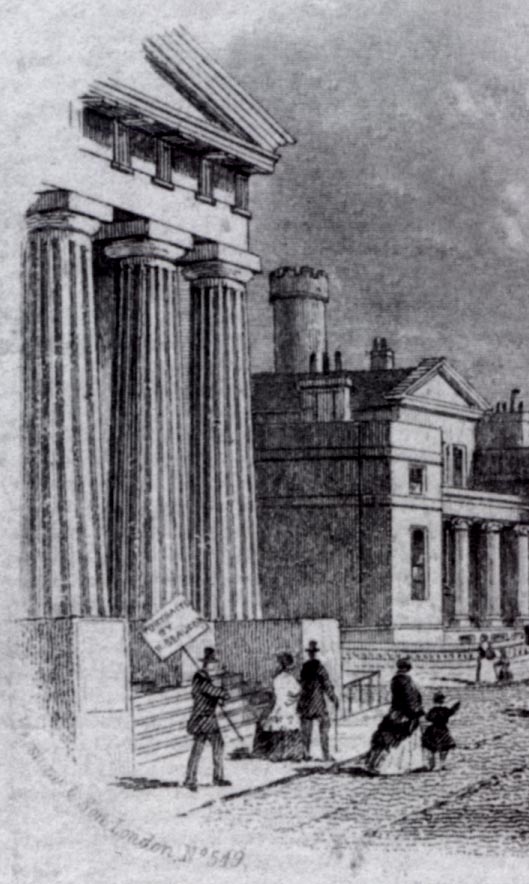
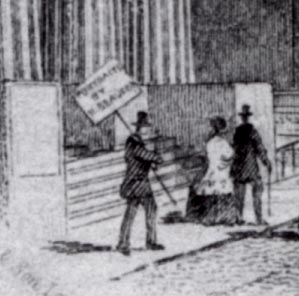
The Assembly Rooms, West Ascent, St Leonards-on-Sea, depicted in an illustration published in 1829. The Assembly Rooms were the centre of all social activity in the town and provided the location of the first photographic portrait studio in Hastings & St. Leonards. Richard Beauford began taking photographic likenesses at the St. Leonards Assembly Rooms in the Summer of 1849. ( Lithograph of the Assembly Rooms drawn in 1829) |
Richard Beauford (born c1816, London )
| Richard Beauford - The Earliest
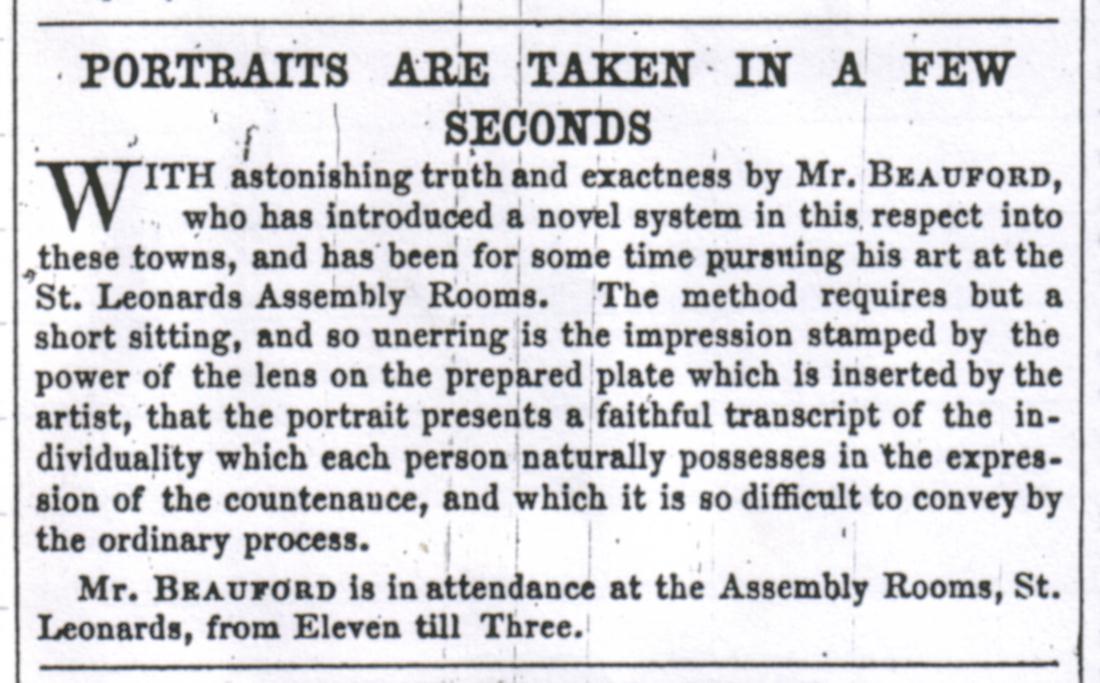
Photographer in Hastings & St Leonards Richard Beauford was the first professional photographer to establish a photographic portrait studio in Hastings & St. Leonards. Born in London around 1816, Richard Beauford began taking photographic likenesses at the Assembly Rooms in St. Leonards during the Summer of 1849. In an advertisement dated 27th August 1850, Beauford claimed to have taken "upwards of 500 portraits of the nobility and gentry ... during these last twelve months at the Assembly Rooms, St Leonards." Although it is clear from his advertisements and from reports in the local press that Beauford was employing the Daguerreotype Process, whereby images were fixed on a silvered copper plate, he studiously avoids the term "Daguerreotype" in his public notices. Instead, Richard Beauford dubbed his small photographic likenesses "Miniatureotype Portraits". It must be remembered that the British entrepreneur Richard Beard (1801-1885) held the patent rights on the daguerreotype process in England and, strictly speaking, Beauford should have purchased a licence from Beard before setting up his photographic portrait studio in St Leonards. William Constable ( 1783-1861), who in November 1841 established the Photographic Institution of Brighton - the first photographic portrait studio in the county of Sussex - reportedly had to pay £1000 to Beard for the privilege. In an early advertisement published in The Hastings & St. Leonards News on 19th April 1850, under the heading "PORTRAITS ARE TAKEN IN A FEW SECONDS", Beauford emphasised that he had "introduced a novel system" of taking portraits. In other notices issued by Beauford in 1850, he refers to "his improved and certain system of MINIATUREOTYPE" and "invites public attention to his novel and very superior method of taking portraits." Beauford seems determined to give the impression that he was using a method that was distinct and different from the daguerreotype process that was covered by Beard's patent. An appreciative item in The Hastings & St. Leonards Chronicle, published on 13th August 1850, makes it clear that Richard Beauford's "Miniatureotype Portraits" were produced by Daguerre's process of fixing images on silvered copper. Praising Beauford's artistry, the author of the article declares that Beauford's coloured likenesses " more resemble a painting on ivory than one of those transpositions which the light of heaven leave indelibly impressed upon the chemically prepared sheet of copper."
|
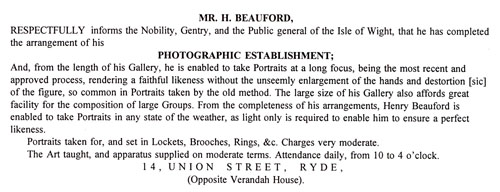
[ABOVE] An early advertisement for Richard Beauford's photographic portraits, which appeared on the front page of The Hastings & St. Leonards News on 19th April 1850. The advertisement stated that Beauford had been "for some time pursuing his art at the St. Leonards Assembly Rooms". Another advertisement in the Hastings & St Leonards Chronicle dated 27th August 1850, indicates that Beauford had been taking photographic likenesses at the Assembly Rooms for a period of 12 months, which suggests he began taking portraits in the Summer of 1849. |
Portraits by Mr. Beauford
|
Daguerreotypes or Miniatureotypes
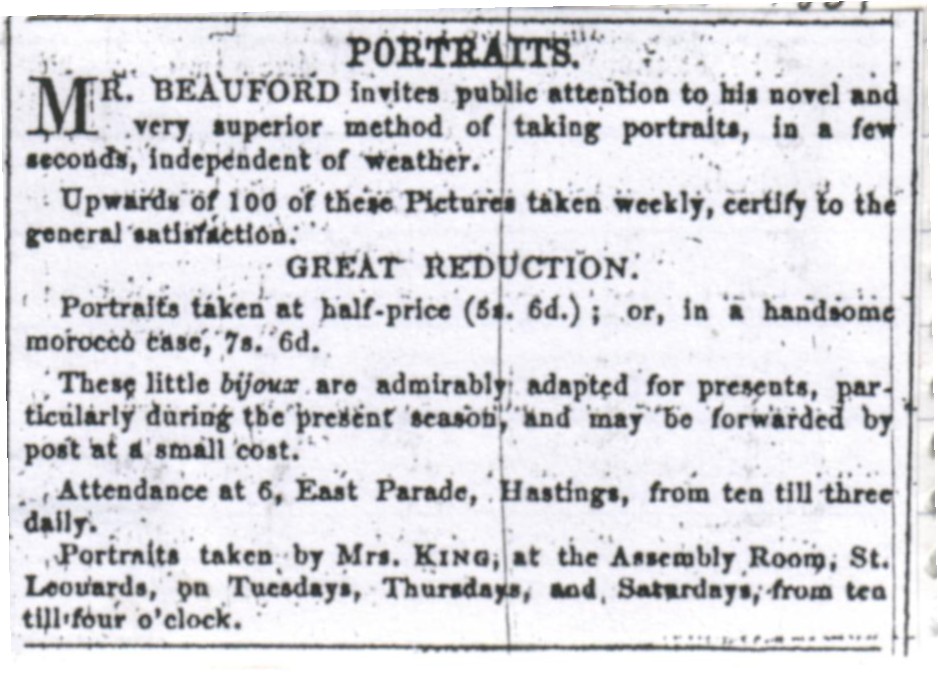
At first, Beauford charged around 11 shillings for one of his "Miniatureotype Portraits", but by November 1850, he had reduced his prices by 50 per cent. An advertisement, dated 15th November 1850, announced : "GREAT REDUCTION DURING THE NEXT MONTH - Portraits taken at half price (5s 6d) ; or, in a handsome morocco case, 7s 6d." Beauford kept the price of a small daguerreotype portrait at 5s 6d until he sold his studio in July 1853.
|
Richard Beauford's Studio on East Parade Hastings
| Beauford's Studio in
Hastings In August 1850, Richard Beauford announced that he had "added a branch establishment" at 6 East Parade, Hastings. Initially, Beauford operated both studios himself ; taking photographic portraits at the Assembly Rooms, St Leonards on Tuesdays, Thursdays and Saturdays and then attending his new studio in Hastings on the alternate days of Monday, Wednesday and Friday. Beauford decided it was best for him to be based at 6 East Parade, Hastings and so he sought assistants to help him run both studios. Beauford was willing to give training to potential assistants. On 27th August 1850, Beauford advertised for "two pupils, who will be taught the art in a few weeks, and to whom the necessary apparatus for practice or professional purposes will be lent on moderate terms". The pupils were expected to pay Beauford a premium of ten guineas for their instruction. By the beginning of 1851, Beauford had opened a "Photographic Class". Richard Beauford revealed that he had set up the photographic class "by particular request". Beauford charged his students £5 for the course of instruction. On 10th January 1851, Beauford announced that only one vacancy remained for his "Photographic Class". Around this time, Richard Beauford was living in St Leonards with his married sister Mrs Maria King. In the 1851 census, Mrs Maria King is described as a 23 year old "Artist" and is shown residing at 8 Undercliff, St Leonards with her young son Richard King (born 1849, Canterbury, Kent) and her older brother, Richard Beauford. In 1849, Richard Beauford (recorded as "Mr R. Beaufort") was living at 110 Marina, St Leonards, but by 1851 he had moved in with his sister. In the 1851 census return, Richard Beauford is entered as a "Heliographist"*, aged 35. * Heliographist. Joseph Nicéphore Niépce (1765-1833), one of the pioneers of photography, used the term "heliograph" to describe the image he produced by exposing a chemically treated metal plate to sunlight. The word is formed from "helios" (the Greek word for "sun") and "graphos" ( writing or drawing ). In other words, an 'heliograph' was "an image made with sunlight". The term 'heliograph' was an alternative to the word 'photograph' ( which roughly means "drawing with light"). A few early photographic artists preferred to call themselves "heliographists" rather than photographers or daguerreotype artists. |
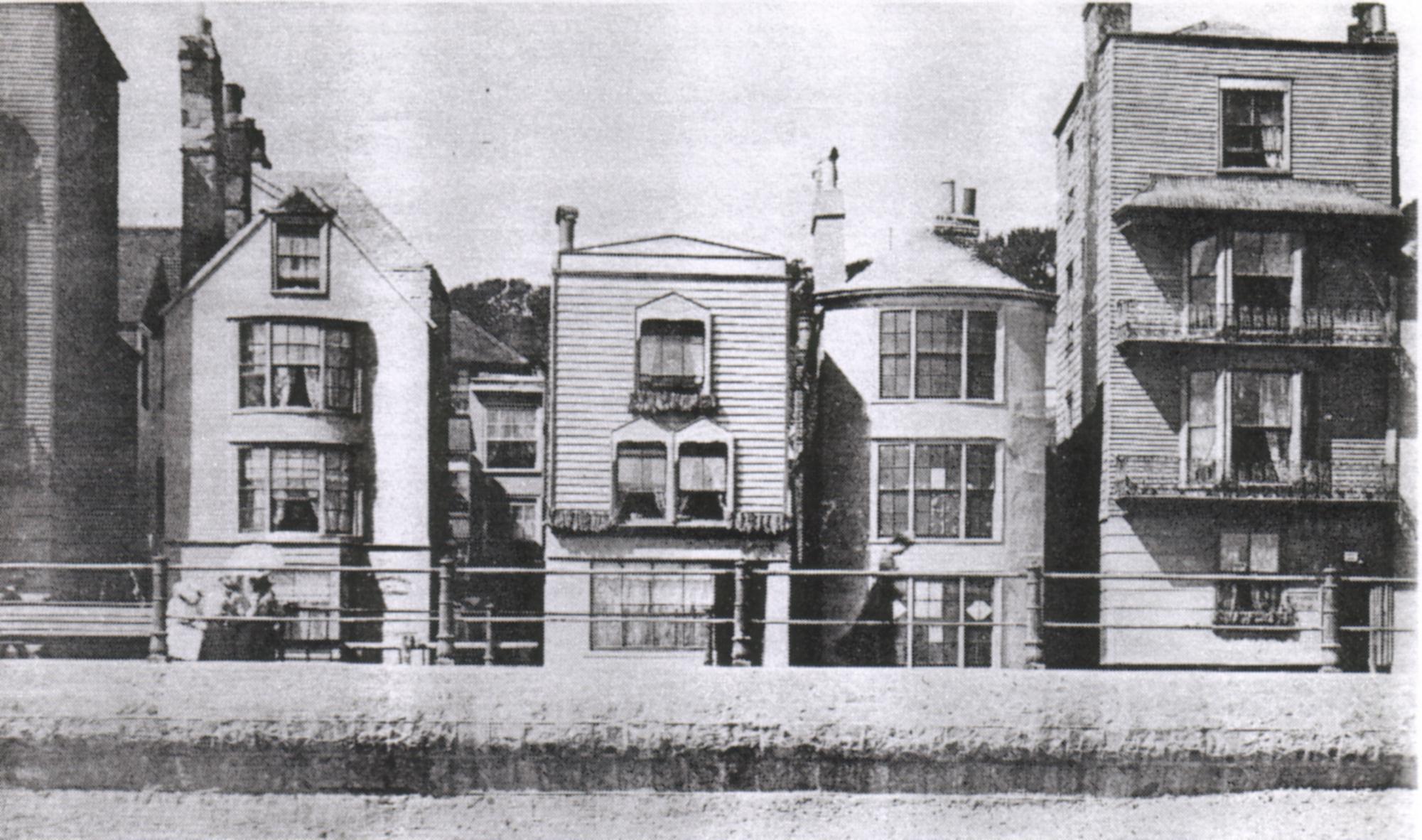
![]() [ABOVE] Number 6, East Parade, a small house faced with wooden slats, can be seen second from the left in this photograph taken in 1900. This building served as a photographic studio from 1850 until about 1862. In 1852, newspaper advertisements gave Beauford's studio address as '5 East Parade, Hastings - the building second from the right with the three sets of large windows. The building at No. 6 East Parade became a beerhouse called The Forester's Arms in the mid 1860s. In recent years it has served as a small restaurant.
|
No. 6 East Parade, Hastings [LEFT] A photograph taken from the beach in 1900, showing the small houses on East Parade, Hastings, where Richard Beauford established the town's first permanent photographic portrait studio in August 1850. Beauford had been taking photographic likenesses at the Assembly Rooms in St. Leonards for a period of 12 months since August 1849, but in an advertisement, published on 27th August 1850, he announced that he had "added a branch establishment" at 6 East Parade, Hastings. ( Advertisements published in 1852 give Beauford's address as No. 5 East Parade ). No. 6, East Parade was used as a photographic studio for a dozen years. Beauford vacated the studio in July 1853. Beauford was succeeded by the firm of White & Connop and, when this partnership ended, it was kept on as a studio by one of the partners, Jacob Henry Connop. In August 1854, the studio passed to William James Golding, a former upholsterer. William Golding worked as a photographic artist in this building until July 1857. At the end of July 1857, the shop at 6 East Parade was put up to let. An advertisement placed in the Hastings & St Leonards News of 31st July 1857 announced "Shop to Let, at 6 East Parade, Hastings, in which the business of a Photographic Artist has been carried on for some years". William Golding set up a new studio at No. 4 York Place, Hastings and entered into a partnership with Anthony Vicat. After the partnership of Golding & Vicat was dissolved in January 1859, William Golding returned to 6, East Parade, Hastings. William Golding eventually moved to 5 Coburg Place, Hastings and the studio at 6 East Parade was let out to Mr R. Hodson, who used it as a photographic studio until the end of 1862. This was the last time that No 6 East Parade was used as a photographic studio. By May 1863, Mr. Hodson, had returned to his former trade of cabinet making.
|
Mrs Maria King of St Leonards - The first woman photographer in Sussex
|
[ABOVE] An advertisement for Richard Beauford's photographic portraits, which appeared in The Hastings & St. Leonards News on 31st January 1851. Mrs King, Beauford's sister and a photographic artist in her own right, is mentioned at the foot of this advertisement [SEE BELOW]. This newspaper advertisement makes it clear that Richard Beauford was based at 6 East Parade, Hastings, where he was in attendance as a photographic artist "from ten till three daily", while Mrs King took photographic portraits at the Assembly Room, St. Leonards, "on Tuesdays, Thursdays, and Saturdays, from ten till four o'clock". Mrs King was first mentioned as a photographic artist in a newspaper advertisement dated Friday, 17th January 1851.
|
Mrs Maria King was possibly the first woman to work as an independent photographer in Sussex. The sister of Richard Beauford, the earliest professional photographer in Hastings & St Leonards, Maria Beauford was born in London around 1828. About 1848, Maria Beauford married Charles William King. By 1849, Charles and Maria King were in Canterbury, Kent, where their son Richard Charles King was born [The baptism of Richard Charles King took place at Canterbury Cathedral on 20th May 1849]. In July 1849, Mrs King was staying at a lodging house at No 7 Undercliff in St Leonards-on-Sea. Richard Beauford, Mrs King's brother, arrived in St Leonards the same year and, in the Summer of 1849, he established a daguerreotype portrait studio at the Assemby Rooms on West Ascent. At the time of the 1851 census, Mrs Maria King is recorded as a 23 year old "Artist", living with her brother and her one year old son, Richard King, at No 8 Undercliff, St Leonards. Maria's husband, Charles King, is not shown as residing at 8 Undercliff. Maria King's brother, Richard Beauford, is described in the census return as a 35 year old "Heliographist" ( Heliographist was an old fashioned term for photographer and referred to a person who made pictures through the agency of the sun ). In January 1851, Mrs King was taking photographic portraits at the Assembly Rooms, St Leonards, while her brother Richard Beauford operated the daguerreotype studio at 6 East Parade, Hastings. Each week, on Tuesday, Thursday, and Saturday, from ten o'clock in the morning to four o'clock in the afternoon, Mrs King was stationed at the Assembly Rooms to take photographic portraits.
[ABOVE] Details of Mary King's household as recorded in the 1851 census return |
||||||||||||||||||||||||||||||
Beauford's Registered Daguerreotype Accelerator
| On 28th February 1851, under the heading
"PORTRAITS - NEW INVENTION", Richard Beauford made the
following announcement : "MR.BEAUFORD having lately invented an
improved Daguerreotype apparatus, is now able to take portraits with
great rapidity and certainty, and with unrivalled effect...The invention
is registered, and Mr. B. has prepared an instrument on his new
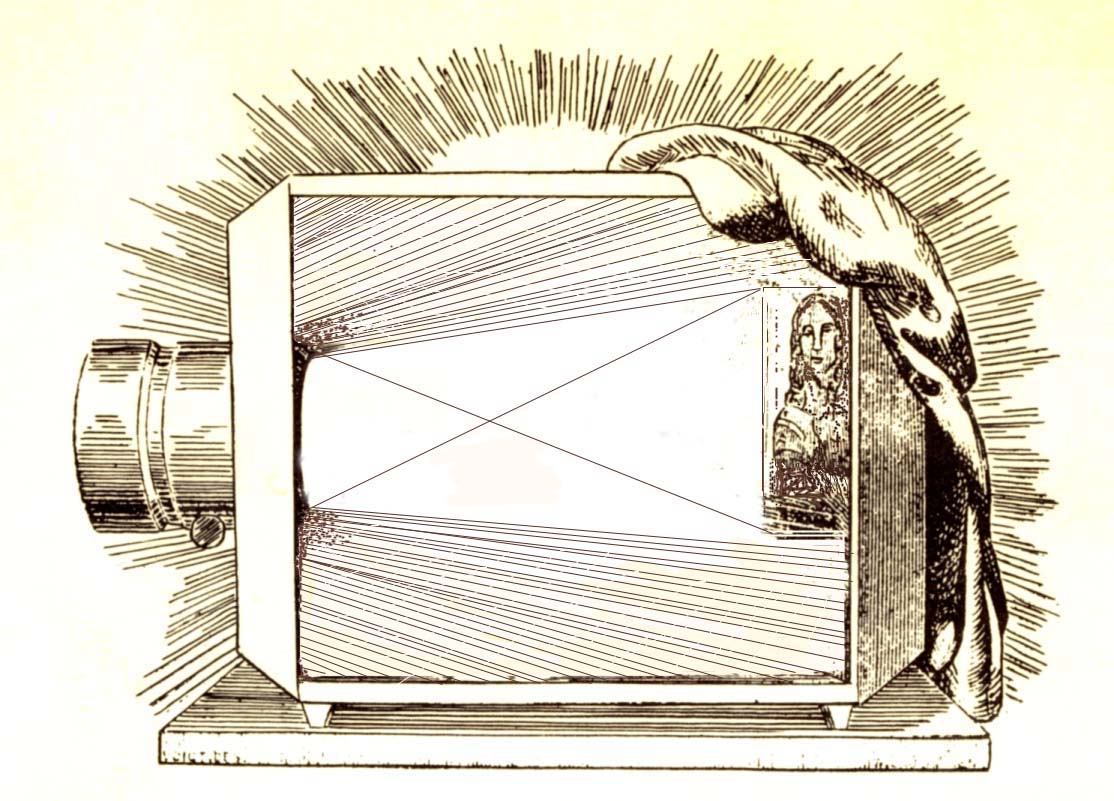
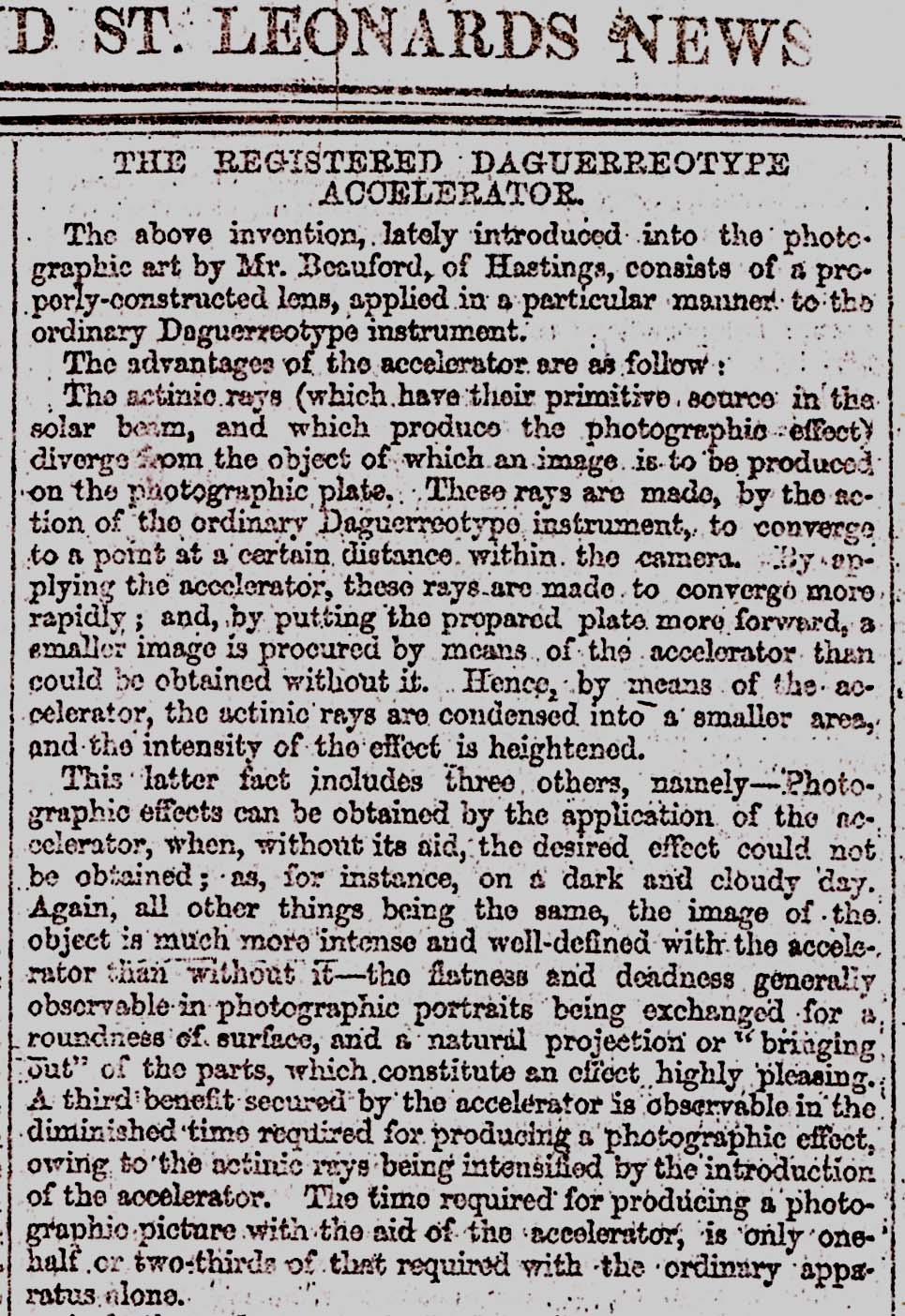
principle for the Great Exhibition." The invention Beauford was referring to in this advertisement was his "Registered Daguerreotype Accelerator" and he did indeed exhibit his invention at the Great Exhibition of the Works of Industry of All Nations when it opened at London's Crystal Palace on 1st May 1851. According to the Great Exhibition's catalogue, Richard Beauford's 'Registered Daguerreotype Accelerator' consisted of " a properly-constructed lens, applied in a particular manner to the ordinary daguerreotype instrument." A fuller account of the Registered Daguerreotype Accelerator appeared in The Hastings & St. Leonards News on 25th April 1851, but the description of the device is not particularly clear. When the daguerreotype process was first introduced in 1839, it was necessary to make improvements in equipment, optics and chemistry to reduce exposure times and thereby make daguerreotype portraiture feasible. Richard Beard, who in 1841 became the proprietor of the first daguerreotype portrait studio in England, acquired the right to use Alexander S. Wolcott's Mirror Camera. Wolcott, an instrument maker from New York, had designed a camera that used a concave mirror instead of a lens. A large opening at the front of Wolcott's camera allowed light to be directed onto a concave mirror, which reflected the received image on to a small daguerreotype plate. The mirror camera allowed more light on to the photographic plate than if it had passed through a lens. Beard also employed the services of the chemist John Frederick Goddard to find a way of reducing exposure times by chemical means. Goddard discovered that bromide and iodine increased the sensitivity of the daguerreotype plate. These innovations shortened exposure times to less than a minute. The various chemical processes used to sensitize photographic plates were generally known as "accelerators". However, the description of Beauford's "Daguerreotype Accelerator" refers to a "properly-constructed lens, applied in a particular manner" and makes no mention of chemicals. The small aperture lens of Daguerre's original camera did not gather enough light and therefore exposure times were lengthy. Wolcott's solution was to replace the lens with a curved mirror. In 1841, Jozef Petzval designed a special portrait lens for Viennese optician Peter Voigtländer. The Petzval portrait lens was over ten times faster than the lenses used in early daguerreotype cameras. By 1850, the Petzval lens had become the standard for portrait photographers. Richard Beauford explained that his modified lens or 'accelerator' intensified the "actinic rays" ( i.e. photochemically active radiation ), resulting in a "diminished time required for producing a photographic effect ". Beauford claimed that "the time required for producing a photographic picture with the aid of the accelerator, is only one-half or two-thirds of that required with the ordinary apparatus alone." Beauford went on to show his Registered Daguerreotype Accelerator at exhibitions in Dublin, New York and Paris. Richard Beauford made it clear in published notices that the 'Registered Daguerreotype Accelerator' had been invented by him and belonged "exclusively to him". Consequently, Beauford offered licences to those photographic artists who wished to employ his daguerreotype accelerator. Licences for the use of the 'Registered Daguerreotype Accelerator' were granted by Beauford at the rate of "One Guinea per annum (Twenty-One shillings a year). When Jacob Henry Connop took over Beauford's Daguerreotype Portrait Gallery in 1853, he made it clear in his advertisements that he was a Licensee for Beauford's Patent Daguerreotype Accelerator. |
|
The sites of Richard Beauford's studios in Hastings & St Leonards today
![]() |
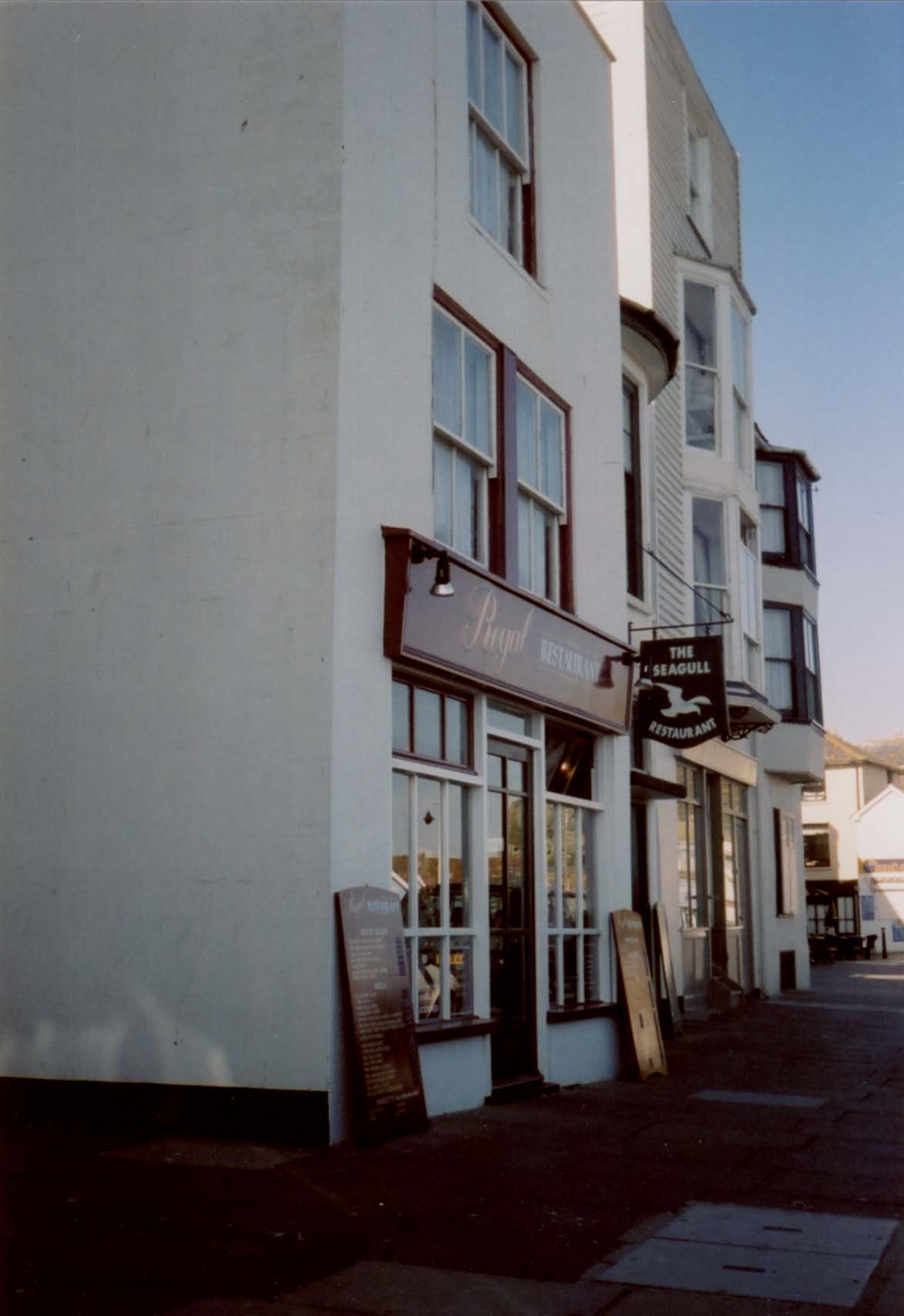
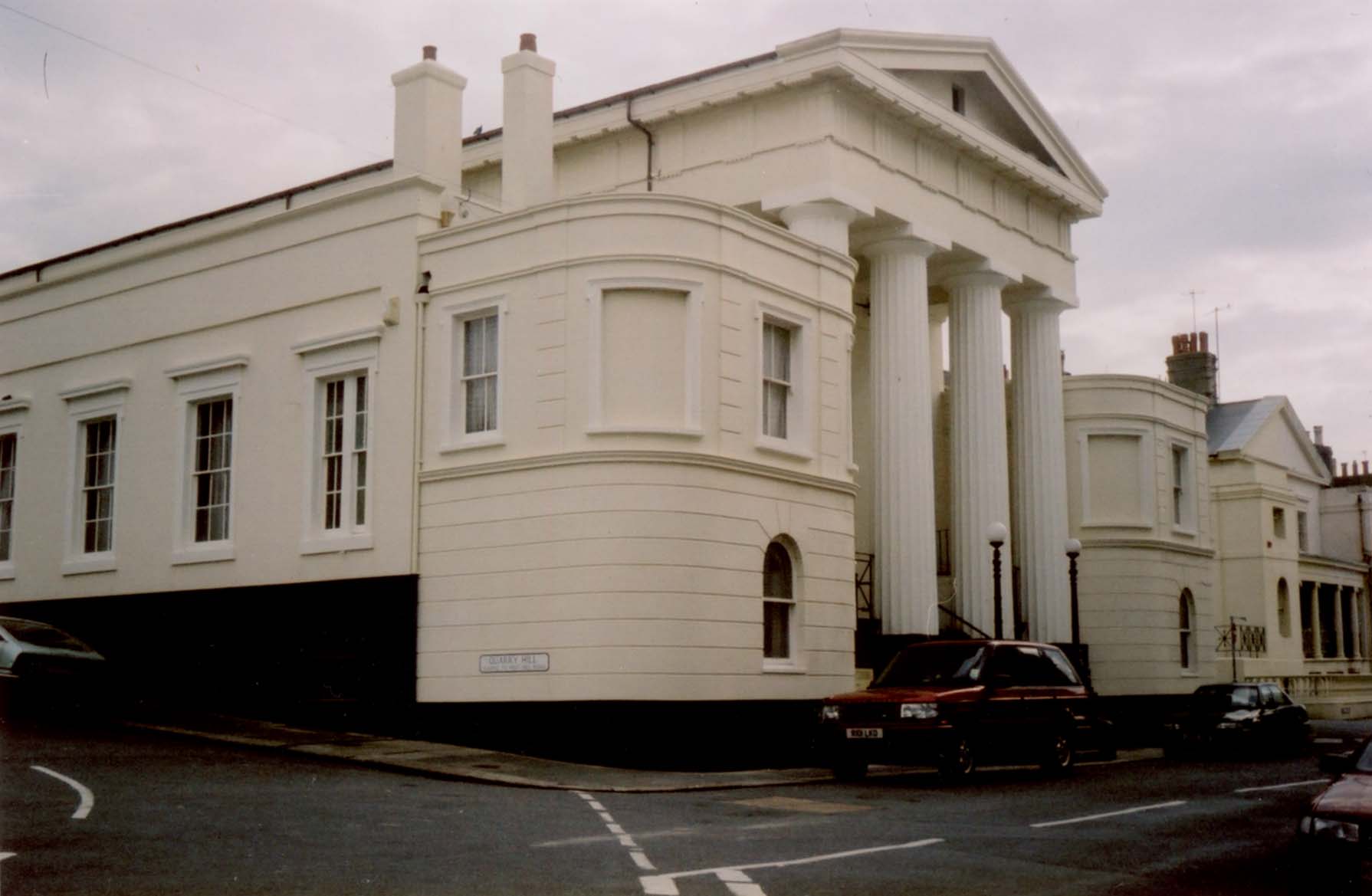
![]() [ABOVE] The Assembly Rooms, West Ascent, St Leonards-on- Sea, in 2006. The building is now known as the Masonic Hall. [LEFT] No. 6 East Parade, Hastings. In 2006, No 6 East Parade housed the Regal Restaurant. |
Beauford on the Move
| As early as May 1851,
Richard Beauford had suggested that he would not stay in Hastings for
very long. On 16th May 1851, Beauford placed a notice in The
Hastings & St. Leonards News announcing his imminent departure from
Hastings. The announcement began as follows : "Mr Beauford,
having engaged extensive premises in Regent Street, London, is about to
REMOVE from Hastings to the Metropolis". The move never took place
and Beauford continued to take daguerreotype portraits in Hastings for
the next two years. Advertisements issued by Beauford in 1852 give his studio address in Hastings as 5 East Parade rather than 6 East Parade. It is not clear whether Beauford had moved next door to number 5, or if the buildings in East Parade were temporarily re-numbered and he was still operating from his original studio premises. Another, but less likely, explanation is that the advertisements in The Hastings & St. Leonards News published between July 1852 and June 1853 had printed number "5" instead of number "6" by mistake. When Beauford's Hastings studio passed to his successor in the Summer of 1853, the address was given as 6 East Parade, Hastings. By May 1851, photographic portraits were no longer being taken at Beauford's former studio in the Assembly Rooms, St. Leonards. In an advertisement published in July 1852, Beauford mentions a second studio in Kent at 1 Garden Terrace, Tunbridge Wells. This could mean that his sister Mrs King, or one of his former pupils, was operating a studio in Tunbridge Wells on his behalf, but the establishment in Kent was not mentioned in advertisements issued later that year. In June 1853, Richard Beauford was still taking portraits at his studio on East Parade, Hastings. However, Beauford issued his last advertisement in Hastings on 1st July, 1853 and by the end of July he had sold his studio on East Parade to Jacob Connop and his business partner Mr White. Interestingly, after July 1853, the firm of White & Connop give the address of their Daguerreotype Portrait Gallery as 6 East Parade, Hastings - the original location of Beauford's Hastings studio. |
Richard Beauford's Photographic Career after 1853
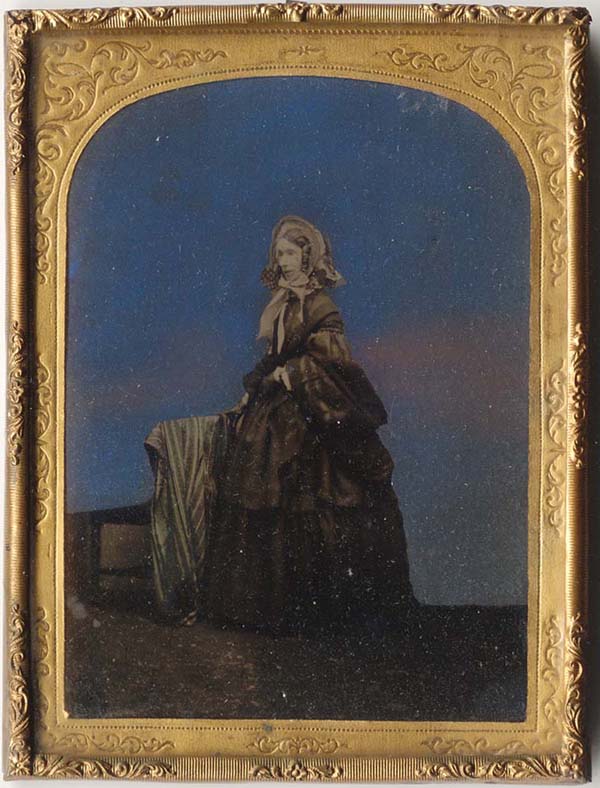
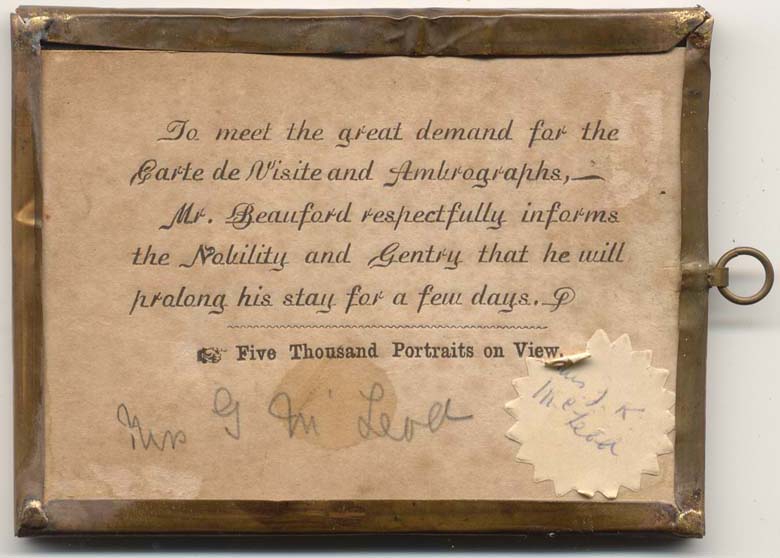
Beauford in Wales After he had disposed of his Hastings studio to White & Connop, Richard Beauford embarked on a career as a travelling photographer. By August 1853, Beauford had set up a temporary studio at Newcastle-under-Lyme, near the Literary and Scientific Institute in Brunswick Street. Beauford remained at Newcastle-under-Lyme for a few months and then moved on from Staffordshire to Shropshire. From May to October 1854, Richard Beauford was based in Castle Street in the town of Shrewsbury. In November, the studio in Castle Street, Shrewsbury was passed to Henry Beauford, a daguerreotype artist who had previously worked on the Isle of Wight. It seems likely that Henry Beauford was related Richard Beauford - possibly his brother. In September, 1854, Richard Beauford visited Aberystwyth with his daguerreotype apparatus and took portraits at No 15 Terrace Road. In October 1854, Richard Beauford set off on an extended tour of Wales and the Welsh borders. Travelling with a portable studio, Beauford visited Hereford, Ross-on-Wye, Monmouth, Abergavenny, Brecon, Carmarthen, Tenby, Newport and Pontypool. Beauford arrived in Newport, Monmouthshire in October 1855 and opened what he described as "The Monmouthshire Photographic Gallery" at the Old Canal Office, High Street, near Newport Bridge, on Monday 22nd October 1855. Publicity flyers informed the inhabitants of Newport that Beauford would be taking portraits at his 'Photographic Gallery' for "ONE FORTNIGHT ONLY". Although Beard's Daguerreotype Patent had expired in August 1853 and Frederick Scott Archer's Collodion Process was being widely used in 1855, Beauford was still producing coloured daguerreotype portraits with the aid of his registered "Accelerator". Richard Beauford favoured the daguerreotype over the collodion positive portrait for both artistic and practical reasons. In a publicity sheet issued in October 1855, Beauford quotes a favourable review of his work which states that "by means of his registered invention, the 'Daguerreotype Accelerator', he is enabled to take likenesses on the dullest day, which surpass, in clearness and exquisite delineation, anything we have ever seen". The review went on to compare Beauford's daguerreotype portraits on 'silver plate' by "contrasting them with recently taken Collodion portraits". The reviewer was struck by the differences between Beauford's daguerreotypes and the collodion positive portraits on glass : "The difference in an artistic point of view, was found to be astonishingly in favour of the former (Beauford's daguerreotypes) and this superiority was the more strongly felt when it was observed that, even in pictures only a few weeks old, the tendency of Collodion to separate from the glass plate had shown itself, to the great detriment of the picture". In 1855, Beauford's daguerreotype portraits started at 5s 6d - a sum which would pay for a small portrait in a frame. Daguerreotype portraits in a "handsome Morocco case" ranged in price from 7s 6d to 25 shillings, depending on the size of the photographic plate. By December 1855, Beauford had reached Pontypool, where he set up a temporary studio at the King's Head Inn. Pontypool appears to have been the last stop in his extended tour of Wales. Richard Beauford's name does not appear as a photographic artist in England or Wales in trade directories published after 1855 and evidence suggests that he ended his photographic career in Ireland. Beauford in Ireland In 1853, Richard Beauford had shown his Registered Daguerreotype Accelerator together with samples of his lenses and examples of his photographic work at exhibitions in Dublin. The catalogue of the International Exhibition held in Dublin in 1853 lists Exhibit No 653 as "Lenses with accelerators" and "Photographs" by 'Robert Beaufort'. It is clear from Beauford's own publicity about showing his work in Dublin, that the name of 'Robert Beaufort' was a printing error and that Richard Beauford was the exhibitor. A detailed catalogue of the contents of The Irish Industrial Exhibition of 1853 mentions "the lenses and accelerators of Mr R. Beaufort (sic)" as one of "several exhibitors of cameras and other apparatus connected with photography". It appears that some time in the 1850s, Richard Beauford returned to Ireland and set up a photographic studio in Sackville Street, Dublin. In the 1860s, it is possible that he entered into a partnership with a photographer named Bruce. In 1865, Beauford & Bruce had a studio in Kilkenny, Ireland. It is recorded that the partnership of Beauford & Bruce exhibited some "Photographic views of Ireland" at the International Exhibition held in Dublin in 1865. The firm of Beauford & Bruce are last mentioned working from a studio at Nun's Island, Galway in the year 1878. By this time, Richard Beauford would have been in his early sixties. |
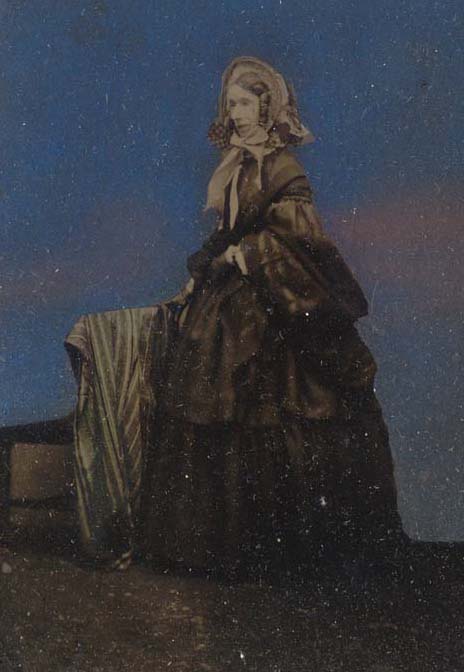
[ABOVE] A daguerreotypes portrait of a woman and child produced by Richard Beauford at Newport, Wales in October 1855. [PHOTO : Courtesy of Alan Cook of Woodstone Antiques and Ruby Lane Inc. ]
|
Example of Mr. Beauford's work as a Travelling Photographer
|
|
|
|
Acknowledgements |
| I am indebted to Bernard & Pauline Heathcote for their wonderful reference work, 'A FAITHFUL LIKENESS - The First Photographic Portrait Studios in the British Isles, 1841 to 1855' (2002) .Thanks also to Alan Cook at Woodstone Antiques and Collectables of Lincolnshire and to Ruby Lane Inc. for allowing me to feature the Beauford daguerreotype of a woman and child, together with its accompanying advertising flyer, which was produced by Richard Beauford at Newport, Wales in October 1855. I have quoted from Beauford's publicity sheet in the section headed 'Beauford in Wales'. Thanks to Jonathan Dickson of Melbourne, Australia for supplying the collodion positive (ambrotype) portrait produced by Mr Beauford around 1860. |